Table of Contents
- What Spout Pouch Food-Contact Compliance Means
- Establish the Regulatory Basis and Intended Use
- Food-Contact Document Types Compared
- Build the File by Package Component
- How to Review a Supplier Declaration
- When Test Reports Are Relevant
- How Pouch Configuration Changes Affect the File
- A Practical Buyer Approval Workflow
- Documentation Gaps to Resolve Before Ordering
A practical guide to building and reviewing a food-contact documentation file for imported spout pouches, including films, adhesives, inks, spouts, caps, test reports, and supplier declarations.
What Spout Pouch Food-Contact Compliance Means
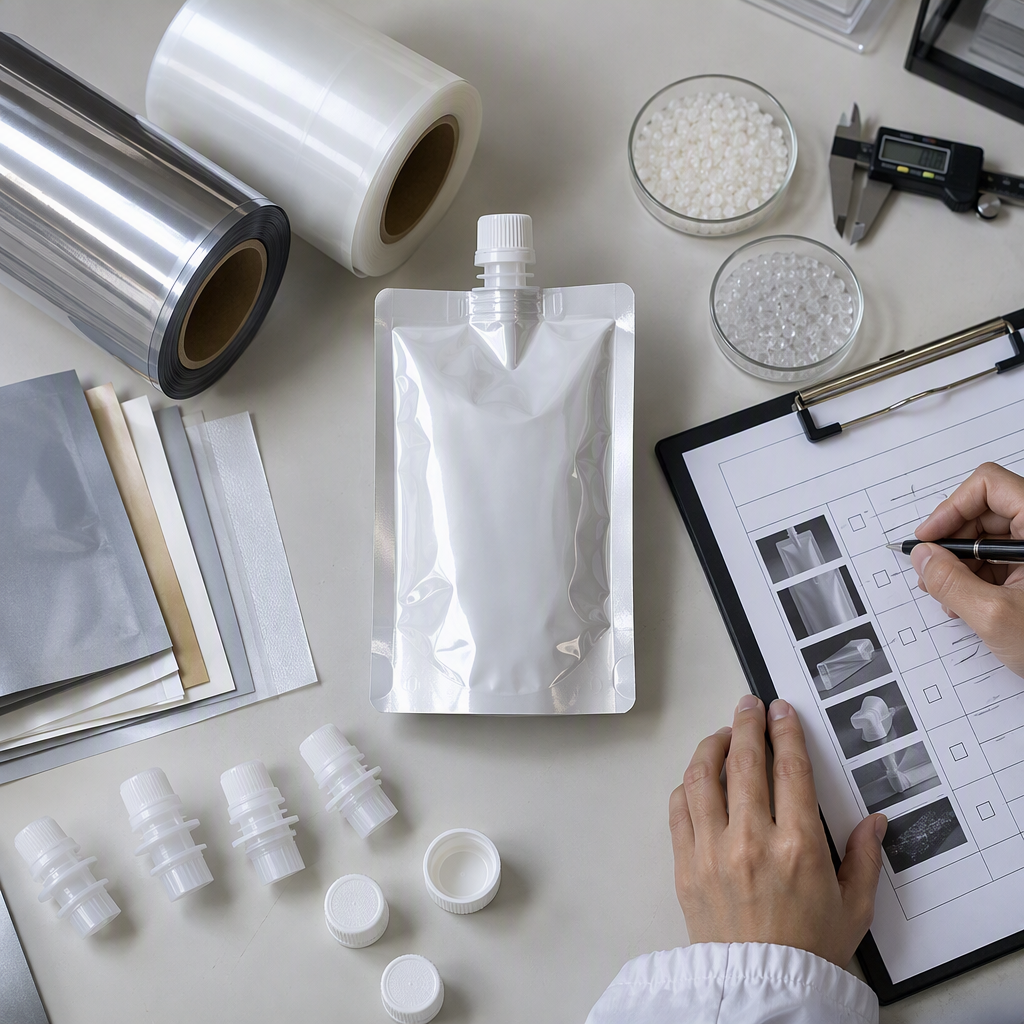
For a US buyer, spout pouch food contact compliance means having evidence that every material reasonably expected to contact the food is suitable for the specified product and conditions of use. The review should cover the pouch’s food-contact film layer, sealant, spout, cap, and any other wetted component. Adhesives, inks, coatings, and additives also require evaluation according to their location and whether a suitable barrier separates them from food.
There is no single universal “FDA certificate” that proves a finished pouch is appropriate for every food and process. US Food and Drug Administration regulations address food-contact substances through different regulatory routes and limitations. A useful buyer file therefore connects the actual package construction to the applicable regulatory basis, intended food type, filling process, temperature, contact duration, and reuse status.
This guide assumes a single-use flexible spout pouch imported for food or beverage packaging in the United States. Retort, aseptic, medical, pharmaceutical, and repeated-use applications may require additional review.
Establish the Regulatory Basis and Intended Use
Start with the application rather than a generic request for an FDA document. The supplier needs enough information to identify applicable limitations for each material. At minimum, provide the food category, fat and alcohol content where relevant, acidity, fill temperature, maximum processing temperature, expected shelf life, storage temperature, and whether the pouch will be microwaved, frozen, refrigerated, or stored at room temperature.
The regulatory basis may include applicable provisions of Title 21 of the Code of Federal Regulations, an effective Food Contact Notification, a Threshold of Regulation exemption, a prior sanction, or another valid status. These routes are not interchangeable. For example, an effective Food Contact Notification is generally specific to the notified substance, manufacturer, or supplier described in the notification. A reference should therefore be checked against the actual supply chain and conditions of use.
The finished pouch converter should identify the construction reviewed, but supporting statements may originate from resin, film, adhesive, ink, masterbatch, or fitment suppliers. Buyers should confirm that cited conditions cover the real application rather than accepting a broad statement such as “FDA approved.” FDA generally regulates food-contact substances; it does not issue a universal approval certificate for every finished pouch.
Food-Contact Document Types Compared

Different records answer different questions. A declaration may explain regulatory status, while a laboratory report records a particular test performed on a defined sample. One should not be treated as an automatic substitute for the other.
| Document | What it should establish | Buyer review point |
|---|---|---|
| Food-contact declaration or compliance statement | Applicable regulatory basis, material identity, conditions of use, restrictions, and issuing party | Confirm that the named material or construction matches the quotation and specification |
| Component supplier statement | Status of a resin, additive, adhesive, ink, spout, cap, or other component | Check supplier identity, grade or code, issue date, and limitations |
| Letter of guaranty | A supplier’s guarantee concerning compliance under stated conditions | Review scope carefully; it does not replace an application-specific technical assessment |
| Migration or extraction test report | Results for defined specimens, simulants, temperatures, durations, and methods | Verify sample traceability and whether test conditions represent the intended use |
| Finished pouch specification | Film structure, thickness, dimensions, fitment, artwork revision, and other agreed details | Use it to connect regulatory records to the actual purchased item |
| Certificate of analysis or conformity | Lot-specific or shipment-specific values or confirmation against agreed criteria | Do not assume it contains complete food-contact regulatory evidence |
Build the File by Package Component

A spout pouch should be reviewed as an assembled packaging system. The following component matrix can be added to the purchase specification or approval checklist.
| Package component | Information to request | Why it matters |
|---|---|---|
| Food-contact film or sealant | Material family, grade or construction code, thickness, regulatory references, use limitations | This layer has direct contact with the product and forms the pouch seals |
| Barrier and outer films | Layer identification, supplier declarations where applicable, and confirmation of separation from food | These layers can affect barrier, processing resistance, and the compliance assessment |
| Laminating adhesive | Adhesive system identification, intended laminate use, cure requirements, and regulatory basis | Incomplete curing or use outside stated limits can change suitability |
| Printing inks and coatings | Print location, ink system statement, curing controls if applicable, and set-off controls | External printing must be managed to prevent unintended transfer or contact |
| Spout and cap | Resin grades, colorant information, regulatory statements, dimensions, and component codes | Both components may contact the food during filling, storage, or dispensing |
| Gaskets, liners, valves, or tamper features | Material identity and food-contact status for each added part | Small closure components are easily omitted from a film-focused review |
| Finished pouch | Approved drawing, bill of materials or controlled construction code, manufacturing revision, and intended use | This connects component evidence to the commercial package |
Request enough identification to maintain traceability without requiring the supplier to disclose proprietary formulations. A controlled material code and a declaration covering that code may be sufficient when exact formulations are confidential.
How to Review a Supplier Declaration
A useful declaration is specific enough to connect a regulatory conclusion to the material being purchased. Review it for the legal name and address of the issuer, document date, product or grade identification, applicable US regulatory citations or other status, restrictions, and an authorized signature or approval.
Conditions of use are critical. A material suitable for refrigerated aqueous food may not automatically be suitable for hot-filled oil, alcoholic concentrate, or long-term room-temperature storage. Compare the declaration with a written application profile rather than reviewing it in isolation.
Also check whether the statement covers only the base resin or the complete finished component. A cap declaration limited to uncolored polypropylene does not necessarily cover a colored commercial cap. Similarly, a sealant-film statement may not cover the completed printed and adhesive-laminated pouch.
Record the document revision and map it to the approved bill of materials. If the supplier changes the film grade, adhesive, ink system, colorant, spout resin, or manufacturing source, the buyer should be notified so the affected evidence can be reviewed again.
When Test Reports Are Relevant

Testing can support a food-contact assessment, but buyers should first define the question the test must answer. A report is meaningful only for the sample, method, analytes, simulants, time, temperature, and acceptance criteria stated in it.
Depending on the material and regulatory basis, supporting work may include extraction testing, overall or specific migration testing, residual solvent analysis, or testing for specified substances. US and European Union food-contact frameworks use different terminology and requirements, so an EU migration report should not automatically be presented as proof of US compliance. It may provide useful technical evidence, but the US regulatory basis still needs to be established.
Check that the report identifies the tested construction, including layer structure, adhesive, ink coverage when relevant, and fitment materials. Confirm whether the specimen was a raw film, laminated film, molded component, or finished pouch. A report for a similar structure is reference information unless a qualified assessment explains why it applies to the production construction.
Food-contact testing also does not replace package performance validation. Leak resistance, seal strength, cap torque, drop performance, barrier, filling-line compatibility, and shelf-life studies address different risks and should be specified separately.
How Pouch Configuration Changes Affect the File
Do not assume one compliance file covers every pouch made with a broadly similar laminate. Capacity, shape, spout position, closure design, and manufacturing method can alter the bill of materials or the way components contact food.
A spout pouch with an integrated carry handle may use a larger format, different reinforcement, or a different construction from a small single-serve pouch. Confirm the final structure and all food-contact surfaces instead of extending approval from another size without review.
A custom-shaped spout pouch may introduce revised seal geometry, artwork coverage, or fitment placement. Shape alone does not determine regulatory status, but any related material or process change should be reflected in the controlled specification and documentation file.
Color changes also need attention. Different masterbatches can carry different regulatory statements or limitations. The same principle applies when changing from a standard cap to a tamper-evident closure, valve, gasket, or dispensing accessory. Each added food-contact component should be identified and reviewed.
A Practical Buyer Approval Workflow
- Define the use case. Document the food type, processing method, maximum temperature, contact time, storage conditions, and expected shelf life.
- Freeze the proposed construction. Identify every film layer, adhesive system, ink location, spout, cap, colorant, valve, and gasket using controlled supplier codes.
- Collect declarations. Obtain current statements for the direct-contact layer and each fitment component, plus supporting records for other materials where required by the assessment.
- Map limitations. Compare regulatory restrictions and conditions of use with the actual product and filling process.
- Review supporting tests. Confirm sample identity, method, conditions, laboratory details, results, and relevance to the production structure.
- Approve physical samples. Keep signed samples, drawings, dimensions, fitment details, and artwork revisions linked to the approved construction.
- Set change control. Require written notification before substitutions or changes affecting materials, suppliers, printing, lamination, closures, or manufacturing location.
- Retain shipment records. Keep purchase specifications, lot references, inspection records, and applicable certificates according to the buyer’s document-retention policy.
For larger liquid formats, the drawing and bill of materials should clearly identify handle construction as well as the closure. Reviewing the available handle spout pouch format can help purchasing and quality teams define which configuration details must appear in the specification.
Documentation Gaps to Resolve Before Ordering
Pause the approval process when the documentation cannot be tied to the proposed pouch. Common gaps include a declaration that names no material grade, a test report for an unidentified sample, an expired or superseded statement, and a claim that all pouch structures are covered regardless of food type or temperature.
Other warning signs include missing spout or cap documentation, unaddressed colorants, an EU-only declaration presented as complete US evidence, and test conditions that do not represent the actual fill and storage process. A generic statement from a trading company also may not establish traceability to the film converter or component manufacturer.
Resolve discrepancies in writing and update the purchase specification before mass production. The buyer’s regulatory or legal team should make the final market-access determination, particularly for novel materials, unusual processing conditions, or regulatory pathways dependent on supplier-specific authorizations.
FAQ
Does FDA issue a compliance certificate for a finished spout pouch?
FDA generally does not issue a universal approval certificate for each finished spout pouch. Compliance is evaluated through the status and permitted use of the food-contact substances in the package. Buyers should request construction-specific declarations, applicable regulatory references, use limitations, and supporting records that cover the film, spout, cap, and other relevant components.
Is an FDA registration number proof that packaging is food-contact compliant?
No. Facility registration and food-contact material compliance address different matters. A registration number does not by itself establish that a specific pouch structure is suitable for a particular food, temperature, or contact duration.
Can one declaration cover both the pouch film and spout?
It can only do so when the declaration clearly identifies and assesses both components. Film and molded fitments often have separate material suppliers and regulatory records. The buyer should verify that the food-contact sealant, spout, cap, colorants, and any gasket or valve are within the stated scope.
Is migration testing always required for a US spout pouch?
Not in every case. The need for testing depends on the materials, regulatory basis, intended conditions of use, available supplier evidence, and the buyer’s risk assessment. When testing is used, its sample identity and conditions must represent the proposed application.
Can an EU food-contact declaration be used for the US market?
An EU declaration or migration report may provide supporting technical information, but it does not automatically establish compliance with US requirements. The supplier should separately identify the applicable US regulatory basis and conditions of use.
When should food-contact documents be updated?
Review the file when a material, component supplier, resin grade, colorant, adhesive, ink system, fitment, manufacturing site, or intended use changes. Buyers should also establish a periodic review schedule so superseded declarations and reports are identified.
What information should a buyer send before requesting compliance documents?
Provide the food or beverage type, relevant fat or alcohol content, acidity, fill and processing temperatures, contact duration, storage conditions, pouch size, film requirement, spout and cap configuration, and whether freezing, refrigeration, microwaving, hot filling, or other processing is expected.
Discuss Your Food-Contact Spout Pouch Requirements
Share your product conditions, proposed pouch structure, spout fitment, artwork, MOQ, sample needs, and quote requirements with HUACANG Packaging for a project-specific packaging discussion.