Table of Contents
- What Does Spout Pouch MOQ Mean?
- What Determines the Minimum Order?
- How Tooling and Setup Affect MOQ
- Printing Method and Printed Pouch MOQ
- MOQ Impact by Pouch Configuration
- Planning MOQ Across Multiple SKUs
- Samples, Trials, and Low-Volume Validation
- How to Plan a Practical Order Quantity
- Information Needed for an Accurate MOQ
Spout pouch minimum order quantities depend on more than pouch capacity. This guide explains how print setup, laminate production, pouch tooling, spout selection, and SKU allocation affect the commercial quantity a manufacturer can quote.
What Does Spout Pouch MOQ Mean?
A spout pouch MOQ is the smallest production quantity a manufacturer will accept for a defined pouch specification, usually for one size, structure, spout configuration, and artwork design. There is no universal MOQ. The workable quantity depends on how much material must be produced, how the pouch will be printed and converted, whether tooling already exists, and how many individual SKUs divide the production run.
For buyers, the important distinction is between a commercial minimum and a technical minimum. A line may be able to make a short quantity, but setup waste, printing preparation, lamination, curing, slitting, spout insertion, inspection, and packing can make that run commercially impractical. A manufacturer may therefore quote both a minimum order and a more economical quantity.
MOQ should also be clarified by unit. A quote might state pieces per design, pieces per size, total pieces across approved designs, linear meters of printed film, or kilograms of laminate. Buyers should confirm exactly how the minimum is allocated before comparing offers.
What Determines the Minimum Order?
A custom pouch minimum order quantity is normally based on the combined requirements of printing, material production, converting, fitment supply, and quality control. Changing one specification can change the quoted MOQ even when pouch capacity remains the same.
- Film structure: A commonly produced laminate may be easier to schedule than a specialized structure requiring a dedicated material run.
- Pouch dimensions: Width, height, gusset depth, and web layout determine how efficiently pouches can be arranged across the production web.
- Printing: Print process, number of colors, artwork count, ink coverage, and finish affect setup requirements and run economics.
- Fitment: Standard stocked spouts and caps may have different purchasing constraints from custom colors, unusual diameters, pumps, or proprietary closures.
- Conversion: Corner-spout, top-spout, shaped, handled, and other configurations require different machine setups and tooling.
- Testing and packing: Inspection plans, leak testing, carton configuration, and pallet requirements can influence the practical run size.
Product compatibility remains more important than reaching a lower number. Film, seals, and fitments must suit the product, filling process, storage conditions, and distribution environment. Buyers comparing manufacturers can use a broader spout pouch supplier evaluation checklist to assess capabilities alongside MOQ and price.
How Tooling and Setup Affect MOQ
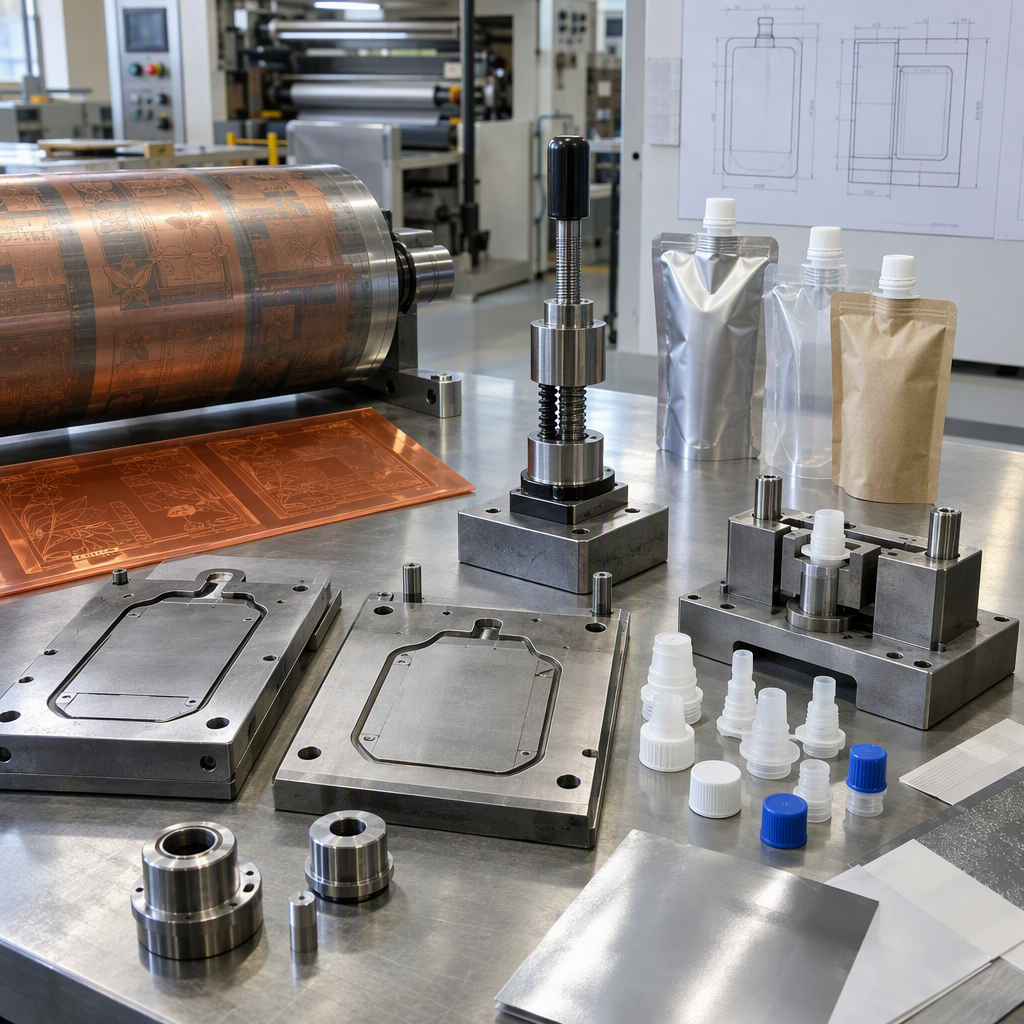
Tooling is often discussed as one cost, but several separate items may apply. Gravure printing uses engraved cylinders, while flexographic printing uses plates. Pouch converting may require a compatible sealing arrangement, cutting die, hole punch, handle punch, or shaped-pouch die. Fitments can require insertion tooling matched to the spout geometry and pouch-making equipment.
A standard rectangular pouch with an established spout is generally less tooling-intensive than a custom silhouette or a newly developed fitment. A custom shape may require a dedicated die and additional setup or waste during conversion. Buyers considering that format should review the practical constraints in this custom shaped spout pouch guide.
Tooling charges and MOQ are related but not interchangeable. Paying a tooling charge does not necessarily remove the production minimum because the converter still needs enough film and machine time to complete a viable run. Ask whether tooling is a one-time charge, whether it can be reused for repeat orders, how artwork revisions affect it, who controls the tooling, and how long it will be retained. These terms should be documented in the quotation.
Printing Method and Printed Pouch MOQ
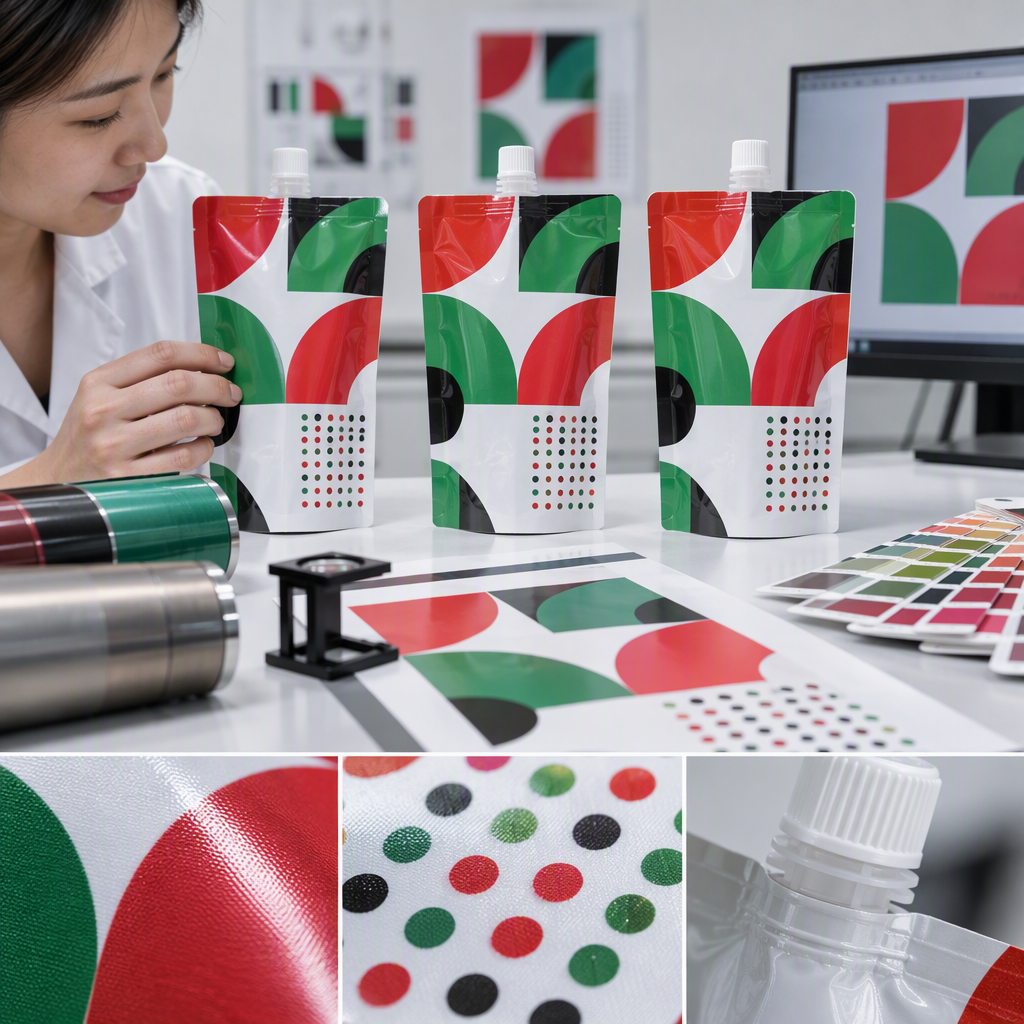
Printing is frequently the main reason that a printed pouch MOQ differs from the quantity expected by a buyer. The best process depends on the converter’s equipment, laminate, artwork, run length, color requirements, and repeat-order plan. The following comparison is directional; actual availability and minimums must be confirmed with the manufacturer.
| Printing method | Prepress requirement | Typical planning advantage | MOQ consideration |
|---|---|---|---|
| Digital | Digital file preparation; usually no conventional plates or cylinders | Useful for trials, several designs, or frequent artwork changes where supported | Can support lower quantities, but material, pouch conversion, fitment, and machine minimums still apply |
| Flexographic | Printing plates and color setup | Suitable for repeat production on compatible films and equipment | Plate cost and press setup must be spread across the run |
| Rotogravure | Engraved cylinders for the print design and color separations | Commonly considered for established designs and longer repeat runs | Cylinder investment and press setup can make very short orders less practical |
Do not choose a print process solely by the stated minimum. Evaluate color targets, image detail, spot colors, surface or reverse printing, matte or gloss effects, registration expectations, and consistency across repeat orders. Request a print proof or color standard appropriate to the process before production approval.
MOQ Impact by Pouch Configuration
The product format determines which materials, tooling, components, and production stages must be coordinated. This table shows how common sourcing choices can affect the flexible packaging MOQ without assigning unsupported universal quantities.
| Pouch configuration | Production inputs | Likely order-planning issue | Buyer action |
|---|---|---|---|
| Unprinted standard-size spout pouch | Existing film, dimensions, and fitment | Availability depends on current stock or scheduled production | Confirm structure, dimensions, spout, cap, and product compatibility |
| Custom-printed standard pouch | Dedicated artwork plus standard pouch geometry | Print setup and minimum material run may determine MOQ | Ask for MOQ per design and total run |
| Custom laminate or barrier structure | Dedicated film construction and possible qualification work | Material production may set a minimum above the converting requirement | Provide shelf-life, filling, storage, and distribution inputs |
| Custom-shaped pouch | Printing, cutting die, conversion setup, and fitment placement | Tooling and web-layout efficiency can affect cost and quantity | Approve the outline, fill volume, and physical sample before launch |
| Custom-color or nonstandard fitment | Dedicated molded component or special procurement | The component supplier’s minimum may exceed the pouch run | Confirm fitment MOQ, lead time, ownership, and excess-component handling |
If a mono-material structure is being considered, treat it as a technical specification rather than only an MOQ decision. The material family, barrier needs, sealing window, and fitment compatibility should be reviewed using a mono-material spout pouch buying guide and validated for the intended product.
Planning MOQ Across Multiple SKUs

SKU count can turn an apparently manageable order into several separate minimums. Different pouch sizes, film structures, spout types, cap colors, or artwork files may each require an independent run. Ten flavors do not automatically share one MOQ simply because they use the same pouch dimensions.
Ask the manufacturer whether designs can be combined and which specifications must remain identical. Depending on the print process and production plan, combined ordering may still require a minimum per artwork. Color changes, metallic effects, white-ink layers, language versions, and regulatory copy can also prevent efficient grouping.
For launch planning, create a matrix listing every SKU against size, fill volume, laminate, spout, cap, print file, forecast, and launch date. Consolidate specifications only where the same package is technically appropriate. Common dimensions and fitments can simplify purchasing, but product-specific compatibility and filling requirements should not be compromised merely to reduce MOQ.
Samples, Trials, and Low-Volume Validation
Buyers searching for low MOQ spout pouches often need validation units rather than a full commercial print run. Clarify the objective before asking for a small order. Existing stock samples can help assess dimensions, handling, and general fitment style, but they do not prove that a custom structure is compatible with the buyer’s formula or process.
Prototype options may include unprinted samples made to proposed dimensions, digitally printed mockups for visual review, fitment samples for filling-line trials, or a pilot production run where the manufacturer’s process allows it. Each option answers a different question. A mockup can reveal artwork placement but may not duplicate final production materials or printing. A physical prototype can support fit and filling checks but does not replace shelf-life or distribution validation.
Use a documented approval sequence covering dimensions, nominal fill volume, headspace, spout position, cap engagement, filling interface, sealing, dispensing, and packed-carton behavior. The spout pouch sample approval process provides a structured way to record decisions before commercial production.
How to Plan a Practical Order Quantity

The lowest accepted quantity is not automatically the best spout pouch order quantity. A useful decision balances unit cost against inventory exposure, forecast uncertainty, storage space, artwork changes, product shelf life, freight, and reorder lead time.
- Forecast demand by SKU: Use a realistic consumption range rather than one total forecast for the entire product family.
- Add operational allowances: Account for filling trials, line setup, quality samples, damaged units, and other planned uses without assuming every delivered pouch becomes saleable output.
- Review inventory duration: Estimate how many weeks or months each quoted quantity represents. Check this against artwork stability, product plans, and available warehouse conditions.
- Compare price breaks: Request prices at the minimum and at one or two higher quantities using the same specification and commercial terms.
- Calculate landed impact: Include tooling, freight, duties where applicable, inspection, warehousing, and the cost of obsolete stock.
- Plan the reorder point: Base it on approved production lead time, shipping mode, customs clearance assumptions, safety stock, and forecast variability.
A simple planning formula is: forecast usage during replenishment lead time plus safety stock and planned trial usage. This calculation does not replace the manufacturer’s MOQ, but it shows whether that minimum fits the purchasing plan. Shelf-life assumptions should be supported by product-specific validation; this spout pouch shelf-life testing guide explains the relevant review process.
Information Needed for an Accurate MOQ
A manufacturer cannot reliably confirm MOQ from capacity and artwork alone. Submit one specification for each SKU and identify which items may be standardized. At minimum, include:
- Product type, ingredients relevant to packaging compatibility, and whether the product contains oil, alcohol, acid, particulates, or other challenging components
- Target fill volume, product density where relevant, pouch width, height, gusset, and preferred spout position
- Filling method, fill temperature, sealing process, line speed target, and fitment interface
- Required barrier function, expected shelf life, storage conditions, and distribution route
- Spout inner diameter, flange style, cap type, cap color, tamper-evidence requirement, and dispensing needs
- Printing method preference if known, artwork count, color count, finish, transparent areas, and variable versions
- Quantity per SKU, annual forecast, desired order frequency, delivery destination, and launch date
- Sample, testing, inspection, carton, pallet, and documentation requirements
Request a quotation that separates unit price, tooling, prepress charges, samples, testing, packing, and freight terms. It should also state quantity tolerance, lead-time basis, artwork approval requirements, payment terms, tooling reuse conditions, and how unused custom fitments or materials will be handled. This creates a clearer comparison than evaluating unit price alone.
FAQ
Can a manufacturer confirm spout pouch MOQ without a complete specification?
Only a preliminary estimate may be possible. A firm MOQ normally requires the pouch dimensions, film structure, spout and cap, printing method, artwork count, order quantity per SKU, filling conditions, and delivery requirements. Missing information can change both the minimum and the quoted unit price.
Does digital printing always provide low MOQ spout pouches?
No. Digital printing can reduce conventional plate or cylinder requirements where the process is available, but the order is still subject to compatible film, pouch-making setup, spout supply, lamination, inspection, and packing minimums. The manufacturer must confirm whether the proposed structure and format can use its digital workflow.
Can several artwork designs share one printed pouch MOQ?
Sometimes, but this depends on the printing process and production arrangement. Designs are easier to evaluate together when pouch size, laminate, spout, cap, finish, and other production specifications are identical. A minimum per design may still apply, so the quotation should state both the total run and the allocation for each SKU.
Are printing cylinders, plates, and pouch tooling included in the unit price?
Commercial treatment varies by supplier and project. Tooling may be quoted separately, amortized into the unit price, or charged again after major artwork or dimension changes. Buyers should request an itemized quote and written terms covering reuse, ownership, storage, maintenance, and replacement.
Will increasing the order quantity reduce the pouch price?
A longer run can spread fixed setup costs across more units and may produce a lower unit quotation, but it also increases inventory, warehousing, cash commitment, and obsolescence exposure. Compare total landed cost and expected consumption, not only the unit price.
How can buyers reduce a custom pouch minimum order quantity?
Ask whether the project can use an established pouch size, compatible standard spout, common cap color, existing laminate, or a printing process intended for shorter runs. Reducing unnecessary SKU variation may also help. Any standardization must still meet product compatibility, filling, barrier, dispensing, and distribution requirements.
Discuss Your Spout Pouch Order Plan
Share your product, pouch structure, spout fitment, artwork versions, target MOQ, sample needs, and forecast with HUACANG Packaging for a project-specific quotation review.