Table of Contents
- Which Filling Method Should You Choose?
- How the Two Methods Differ
- Through-Spout Filling Process
- Open-Top Filling Process
- Through-Spout vs Open-Top Comparison
- Product and Process Selection Table
- Pouch Specifications to Confirm
- Line Trials and Quality Validation
- Buyer Decision Checklist
Through-spout filling uses a pouch with the fitment already welded in place, while open-top filling introduces product through an unsealed pouch opening before the final seal is made. This guide compares the equipment, pouch specifications, operating risks, and product conditions that packaging buyers should evaluate.
Which Filling Method Should You Choose?
The choice between the main spout pouch filling methods depends first on the filling equipment and product behavior. Through-spout filling is generally the logical starting point when a pre-made pouch arrives fully perimeter-sealed with its spout already welded in place. Open-top filling is appropriate when the line needs a wider filling opening and can form a reliable final top seal after dosing.
Through-spout filling reduces post-fill pouch sealing operations, but the product must pass through the fitment bore without unacceptable restriction, splashing, foaming, or blockage. Open-top filling accommodates a larger nozzle and can be more forgiving for viscous products or products containing particulates, but it adds a critical top-sealing step. If the fitment is also inserted after filling, the line must accurately position and weld the fitment without contaminating its sealing surfaces.
This guide assumes the package is a pre-made flexible pouch. Form-fill-seal systems, aseptic filling, retort process development, and other validated thermal processes involve additional equipment and product-safety requirements.
How the Two Methods Differ
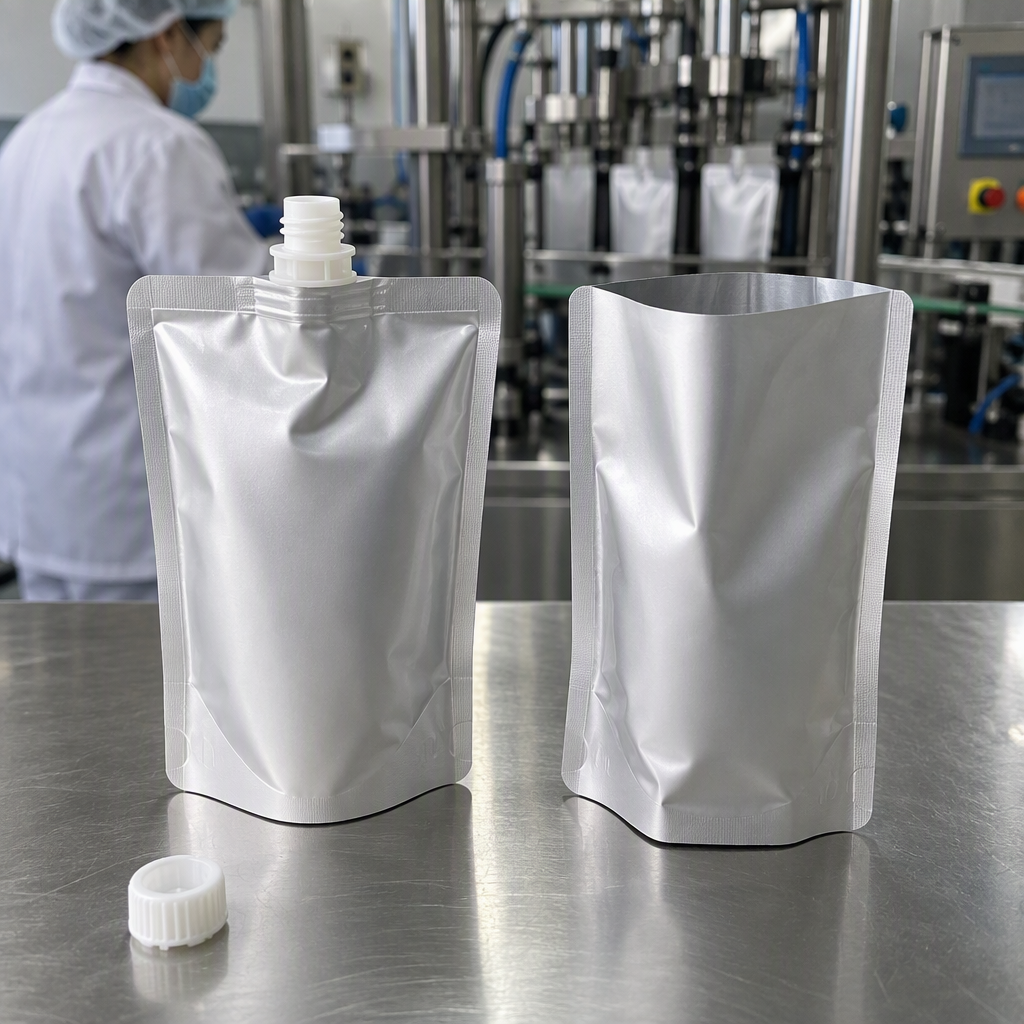
Through-spout filling means the pouch manufacturer supplies a pouch with its perimeter seals and spout-to-film weld already completed. The filler introduces product through the open fitment bore and then applies the cap or closure. The fitment is both the filling path and the consumer dispensing outlet.
Open-top pouch filling means at least part of the pouch top remains unsealed when it reaches the filling line. Product is dosed through that wide opening, after which the line seals the open edge. The spout may already be welded into a corner or top seam, or the line may perform spout insertion after filling.
These configurations should not be treated as interchangeable bag details. They affect pouch dimensions, fitment orientation, seal-area preparation, filling nozzles, pouch handling, inspection points, and the division of responsibility between the pouch converter and the contract packer or brand owner’s plant.
Through-Spout Filling Process
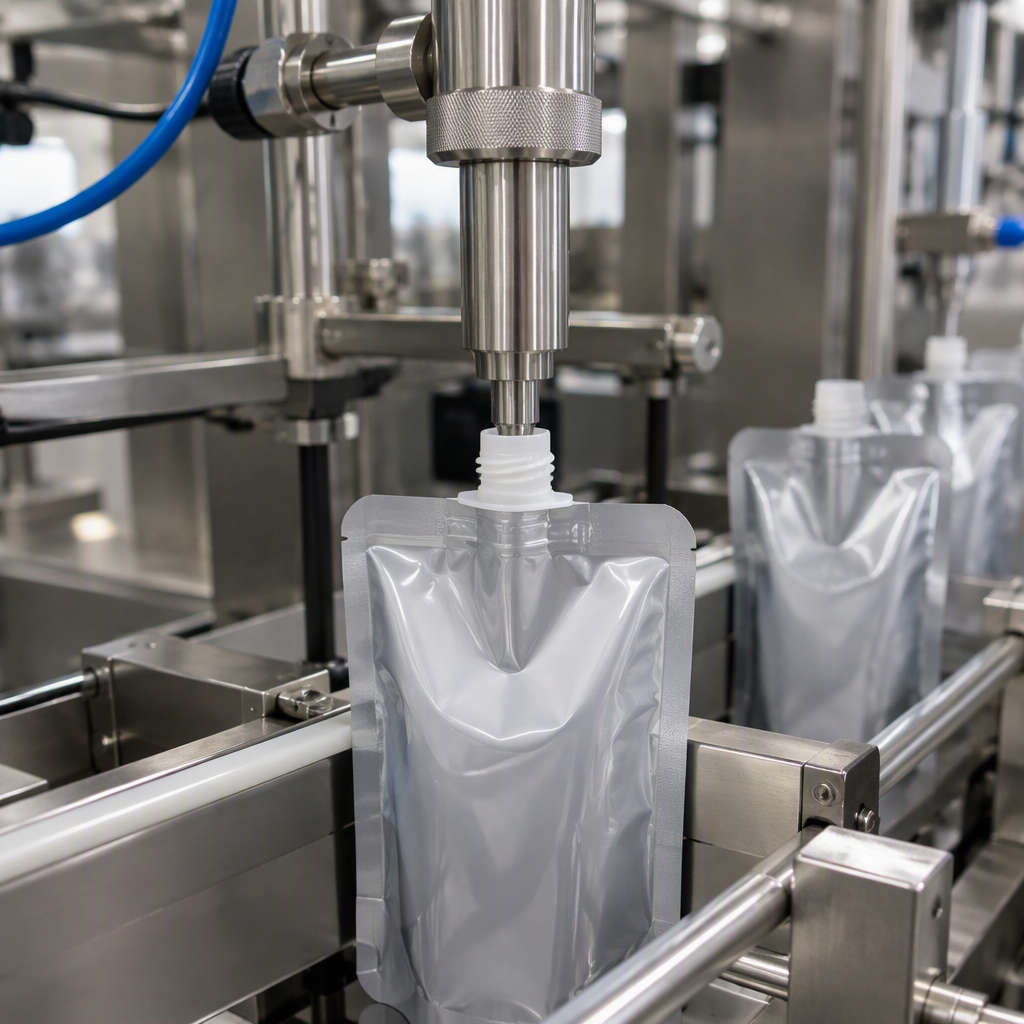
A typical line used to fill through a spout pouch receives uncapped pouches with the fitment already attached. Depending on the automation level, pouches may be manually loaded, placed into rails, or transferred by robotic or mechanical handling. The line locates and supports the pouch by the fitment or pouch body, inserts or aligns the filling nozzle, doses the product, controls drips, and applies the closure.
- Pouch loading: The line presents each fitment in a repeatable position. Fitment flange and neck dimensions must match the grippers, rails, and locating components.
- Nozzle engagement: The nozzle enters or seals against the spout as required by the equipment. The nozzle outside diameter, spout inside diameter, and insertion depth need adequate clearance.
- Product dosing: The line controls the target quantity by weight, flow measurement, piston displacement, time-pressure control, or another system suitable for the product.
- Nozzle withdrawal and drip control: Shutoff nozzles, suck-back settings, or product-specific timing may be used to limit residue on the fitment neck.
- Cap application: The closure is fed, positioned, and tightened according to the closure and equipment specification.
- Inspection: Checks may include fill quantity, cap presence, application torque, fitment cleanliness, leakage, coding, and package appearance.
The primary constraint is the available flow path. A small spout bore can increase filling time or pressure, especially with high-viscosity products. Fibers, seeds, pulp, or other particulates can bridge at the nozzle or fitment. Foaming products may require lower filling velocity, staged filling, more headspace, or a nozzle arrangement developed through trials.
Open-Top Filling Process
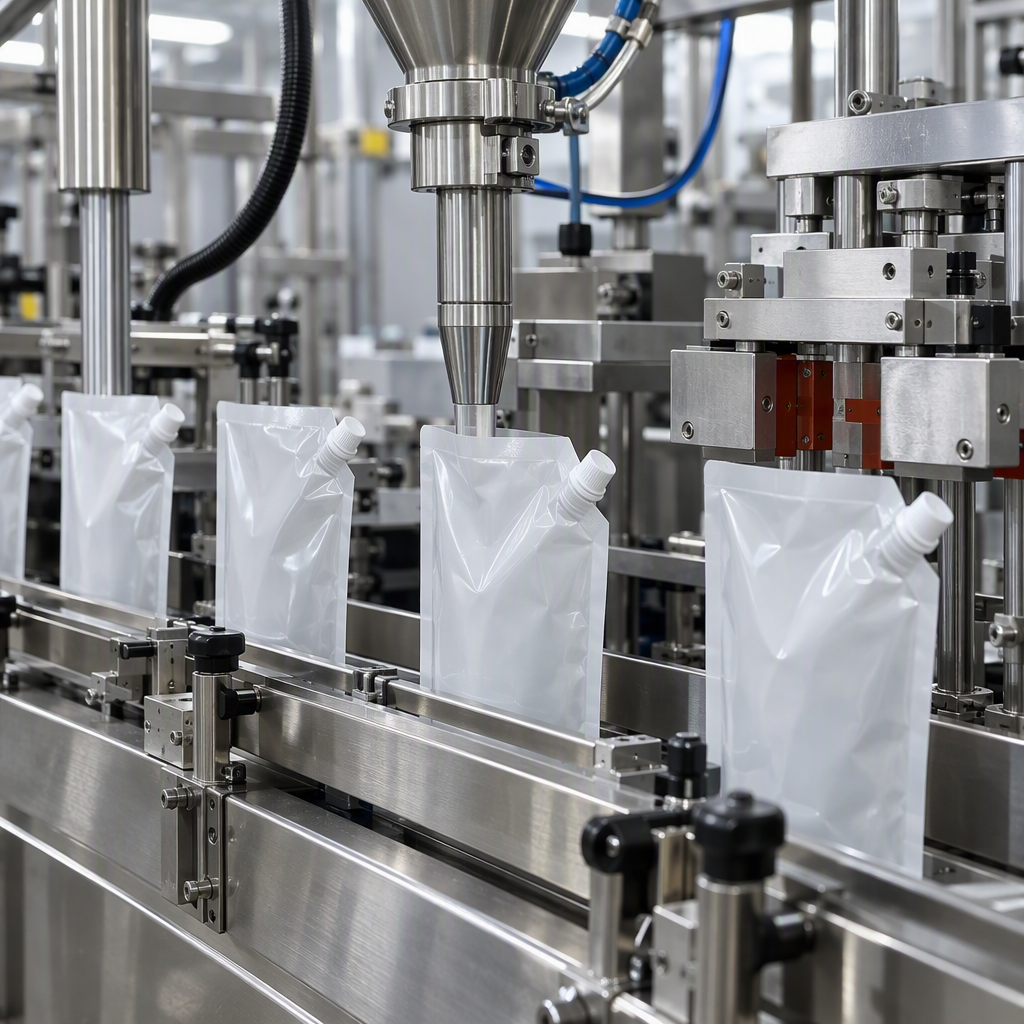
In open top pouch filling, the line opens the unsealed mouth, doses product through a comparatively wide opening, and closes the package with a heat seal. The pouch may have a pre-attached corner spout below the open edge. Alternatively, the line may insert the spout after filling and weld the fitment flange into the designated pouch area.
- Pouch presentation: The line separates, opens, and supports the pouch without damaging the film or gusset.
- Filling: A larger nozzle can enter the open top, reducing dependence on the final dispensing-spout diameter.
- Seal-area management: The line must keep product, condensation, oil, and foam away from the area that will be sealed.
- Fitment insertion, when applicable: Equipment positions the fitment flange between film layers and applies the required sealing cycle.
- Top sealing: Controlled temperature, pressure, dwell time, alignment, and cooling create the final closure seal.
- Inspection: The filled package is checked for seal continuity, wrinkles, channel leaks, fitment position, fill quantity, and closure condition.
The wider opening can help with products that are difficult to move through a narrow spout. However, product on the seal area can create channels or weak regions. Pouch height, fill level, headspace, and handling acceleration must therefore be coordinated to prevent liquid from surging into the seal zone.
Post-fill fitment insertion requires equipment designed for the specific flange geometry and film structure. Buyers should not assume that a fitment qualified for converter installation will automatically run on a filling line. Seal-jaw tooling, fitment orientation, flange ribs, sealing layer, and process window all need confirmation.
Through-Spout vs Open-Top Comparison
The following comparison identifies practical differences for a pre-made pouch filling project. Actual line speed and process capability cannot be determined from the method alone; they depend on the equipment, pouch format, fill volume, product properties, and required controls.
| Decision factor | Through-spout filling | Open-top filling |
|---|---|---|
| Pouch supplied to filler | Perimeter sealed, fitment installed, normally uncapped | Top left open; spout may be pre-attached or installed after filling |
| Filling opening | Limited by fitment bore and nozzle clearance | Defined by open pouch width and machine access |
| Final package-closing operation | Closure application | Top heat sealing plus closure handling; fitment welding may also occur |
| Typical strength | Fewer post-fill film-sealing operations | Large filling access independent of dispensing-spout bore |
| Primary process concern | Flow restriction, fitment contamination, and cap application | Seal-area contamination, wrinkles, alignment, and sealing consistency |
| Fitment requirements | Neck and bore must suit the nozzle, rails, grippers, and capper | Pre-attached fitment must survive handling; line-inserted fitment must suit sealing tooling |
| Useful for product development | Best evaluated with viscosity, particle size, temperature, and foaming data | Best evaluated with seal contamination risk, fill level, and final sealing requirements |
| Quality checkpoints | Spout weld, fill weight, neck cleanliness, cap presence, torque, and leakage | Fill weight, final top seal, fitment weld when line-applied, cap, and leakage |
Product and Process Selection Table
Product category alone does not determine the filling method. Use measured properties and actual line trials. The table provides an initial screening framework rather than a final equipment recommendation.
| Product or process condition | Initial method to evaluate | Reason and questions to resolve |
|---|---|---|
| Low-viscosity, particle-free liquid | Through-spout | Often compatible with the fitment flow path. Check splashing, foaming, nozzle shutoff, and cap-area cleanliness. |
| Moderately viscous sauce, puree, gel, or concentrate | Either method | Compare fill time and pressure through the selected bore against the top-sealing controls required by open-top filling. |
| Product with suspended particulates or fibers | Open-top as an initial screen | A larger opening may reduce blockage, but particle dimensions, settling, nozzle design, and seal contamination still require trials. |
| Foaming cleaner or personal-care liquid | Either method | Assess staged filling, nozzle depth, fill speed, headspace, drip control, and foam entering the cap or seal area. |
| Product filled at elevated temperature | Either method after compatibility review | Confirm film, sealant, fitment, closure, handling, and cooling conditions for the specified temperature and process. |
| Validated retort process | Process-specific evaluation | The package, closure, filling operation, residual air, and thermal process must be developed as a complete system. |
| Frequent changeovers or several spout sizes | Depends on line tooling | Compare change parts, recipes, rail dimensions, nozzle sizes, cap handling, seal jaws, and cleaning requirements. |
For thermally processed products, consult the detailed discussion of retort spout pouch materials and processing. A standard ambient-fill configuration should not be assumed suitable for retort or another elevated-temperature process.
Pouch Specifications to Confirm

A reliable liquid pouch filling process starts with a specification shared by the buyer, pouch converter, fitment supplier, and filling operation. At minimum, confirm the following information before production tooling and printed-pouch quantities are approved:
- Product data: Composition relevant to packaging compatibility, viscosity range at the actual filling temperature, density, particle dimensions, foaming behavior, oil or solvent exposure, and required fill quantity.
- Process conditions: Ambient, cold, hot-fill, or other processing conditions; target product temperature at pouch contact; expected fill rate; cleaning method; and cooling or downstream handling.
- Pouch format: Nominal capacity, target fill volume or weight, finished dimensions, bottom or side gusset, spout position, and required headspace.
- Fitment dimensions: Neck finish, inside bore, flange geometry, cap interface, tamper-evident features if specified, and dimensions used by rails or grippers.
- Laminate: Layer construction, total thickness, sealing-layer identity, barrier requirements, and compatibility with the product and process.
- Seal requirements: Seal widths, fitment weld geometry, top-seal location for open pouches, registration tolerance, and areas that must remain free of print, varnish, or product.
- Closure controls: Cap type, application method, equipment interface, torque specification established for the closure system, and any required opening or tamper-evidence checks.
- Delivery configuration: Pouch orientation, packing count, fitment direction, bag or carton protection, and whether closures are shipped separately.
Material structure also affects fitment welding and top-seal behavior. Buyers considering a single-polymer design can review the processing and compatibility points in the guide to mono-material spout pouches. Material changes should be requalified on the intended filling and sealing equipment.
Line Trials and Quality Validation

Drawings and samples can confirm dimensions, but they cannot fully predict how the package will behave with the actual product and production line. Conduct trials using the intended laminate, fitment, cap, pouch size, product or technically justified product simulant, fill temperature, and equipment settings.
During a through-spout trial, observe pouch loading, fitment location, nozzle clearance, filling time, pressure, splashing, foaming, dripping, cap feeding, cross-threading, application torque, and deformation around the spout weld. During an open-top trial, observe pouch opening, nozzle access, product surge, contamination of the seal area, fitment insertion where applicable, seal alignment, wrinkles, cooling, and filled-pouch handling.
Trial records should identify equipment, change parts, settings, material lot, fitment and cap references, product conditions, target fill quantity, sample size, defects, and agreed acceptance criteria. Approved settings should be transferred to production controls rather than relying on an unrecorded visual judgment.
Leak evaluation should cover the failure modes relevant to the package: pouch seals, the fitment-to-film weld, closure engagement, and the final top seal when present. The appropriate method and acceptance criteria depend on the package and distribution requirements. See this overview of spout pouch leak testing methods when building an inspection plan.
Filling success does not by itself establish shelf life. Product compatibility, barrier performance, closure integrity, storage conditions, and changes over time should be evaluated under a defined protocol. The spout pouch shelf-life testing guide explains the information buyers should align with their suppliers and testing partners.
Buyer Decision Checklist
Before requesting a production quotation, ask the filler or equipment supplier which pouch presentation the line accepts. A statement that the line runs pre-made pouches is not specific enough. Confirm whether it requires an open top, a pre-attached uncapped spout, a particular spout neck, or a line-inserted fitment.
- Can the product pass through the proposed spout and nozzle at an acceptable operating condition?
- What are the maximum particle dimensions and expected viscosity range at filling temperature?
- How does the line hold and locate the pouch and fitment?
- Does the filler make a final film seal, weld the fitment, apply the cap, or perform all three?
- Which sealing surfaces must remain free of product?
- What pouch and fitment dimensions are critical to the equipment?
- Which change parts and tooling are required for the selected format?
- How will fill quantity, closure application, seal integrity, coding, and leakage be checked?
- What sample quantity is required for engineering and production trials?
- Who owns approval of line settings, package specifications, and filled-package testing?
Include these answers, drawings, product information, forecast quantities, and test requirements in the sourcing package. The spout pouch RFQ checklist provides a broader list of technical and commercial inputs for supplier review.
FAQ
What is the difference between through-spout and open-top pouch filling?
Through-spout filling introduces product through a fitment that has already been welded into a fully perimeter-sealed pouch. The cap is applied after filling. Open-top filling introduces product through an unsealed pouch mouth, after which the line makes the final top seal. The spout may be pre-attached or inserted and welded after filling.
Can a viscous product be filled through a spout?
Possibly, but suitability depends on measured viscosity at the filling temperature, spout bore, nozzle dimensions, available pressure, required fill time, product shear behavior, and drip control. A production-representative trial is needed. Selecting a larger dispensing spout only for faster filling can also affect consumer use, closure size, pouch appearance, and cost.
Is open-top filling better for products with particles?
A wide top opening may accommodate a larger nozzle and reduce restriction compared with a narrow fitment. However, particle size distribution, settling, dosing accuracy, nozzle shutoff, and contamination of the final seal area still need evaluation. The product and equipment should be tested together.
Can the spout be inserted after the pouch is filled?
Yes, if the line is specifically equipped for spout insertion after filling. It must position the fitment flange between the film layers and create a consistent weld while keeping the sealing surfaces clean. The fitment geometry, sealing layer, jaws, temperature, pressure, dwell time, and cooling conditions must be compatible.
Does through-spout filling eliminate heat sealing?
It normally eliminates the need for the filler to make the pouch’s final top film seal because the converter supplies the pouch with completed perimeter and fitment welds. Heat sealing was still used to manufacture the pouch and attach the fitment. After filling, the line generally applies the closure and performs the specified inspections.
What information does a pouch manufacturer need from the filling line?
Provide equipment make and model where available, pouch loading method, rail or gripper dimensions, nozzle dimensions, required fitment neck and flange geometry, cap application method, top-seal or fitment-sealing tooling, fill temperature, product properties, target quantity, line speed objective, and sample requirements. Equipment drawings or approved reference samples help prevent dimensional assumptions.
How should buyers validate a new pouch filling method?
Start with dimensional and material review, then run engineering samples under representative product and process conditions. Record settings and inspect fill quantity, seals, fitment welds, closure application, leakage, coding, handling, and appearance. Distribution, compatibility, and shelf-life testing should follow a protocol appropriate to the product and market rather than being inferred from a successful filling trial.
Discuss Your Spout Pouch Filling Requirements
Share your product properties, filling method, pouch structure, spout fitment, artwork, target quantity, MOQ expectations, and sample needs with HUACANG Packaging for a technical review and quotation.