Table of Contents
- What a Beverage Spout Pouch Must Be Designed Around
- Specification Starting Points by Beverage Type
- Barrier and Material Selection
- Compare Ambient, Hot-Fill, and Aseptic Requirements
- Spout and Closure Specifications
- Pouch Format, Capacity, and Usable Volume
- Testing and Validation Before Production
- Beverage Spout Pouch RFQ Checklist
- Samples, Artwork, and Order Planning
A practical guide to specifying spout pouches for wine and other beverages, including material structures, oxygen and light barriers, filling conditions, fitments, pouch formats, and validation requirements.
What a Beverage Spout Pouch Must Be Designed Around
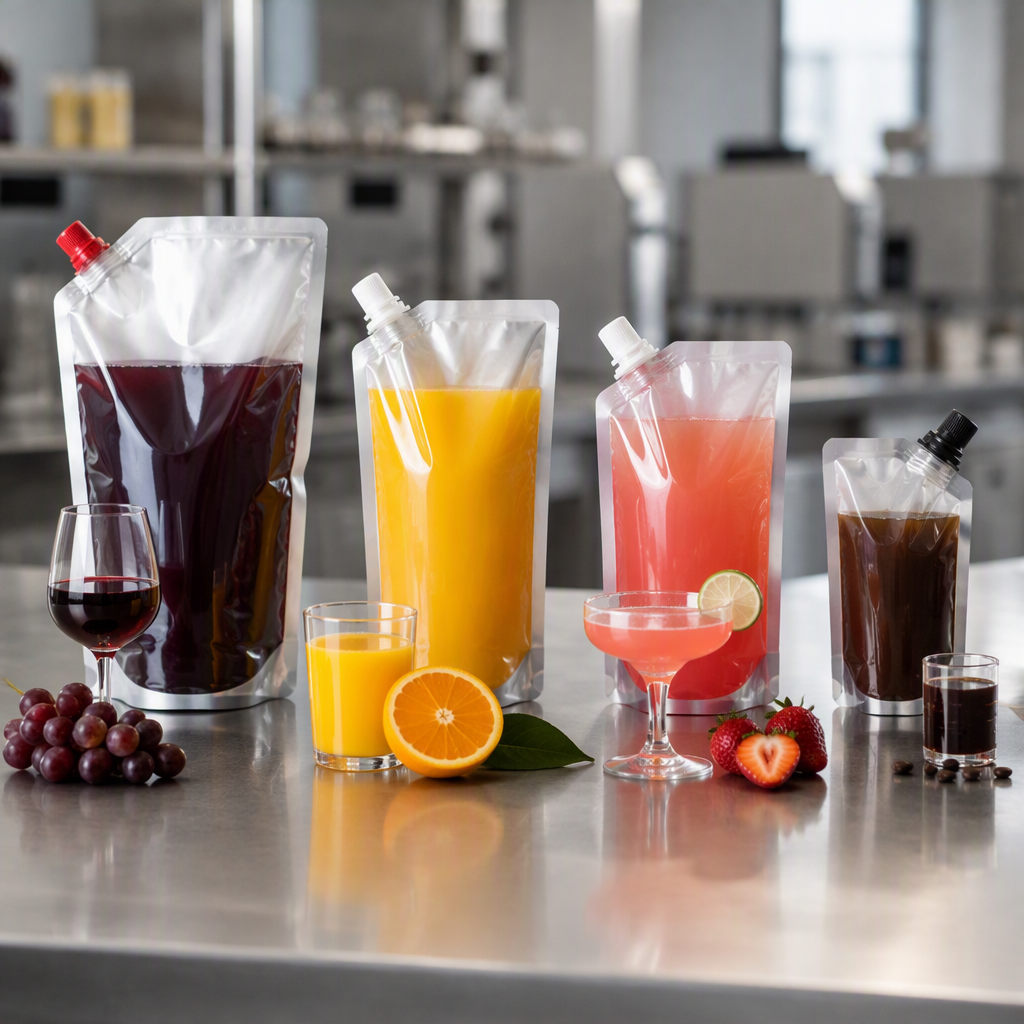
A beverage spout pouch should be specified around the beverage formulation, required shelf life, filling process, distribution conditions, and dispensing experience. For wine, oxygen and light protection may be especially important. Juice, cocktails, mixers, and concentrates can introduce different acid, aroma, temperature, and viscosity requirements. A pouch structure should therefore not be chosen from capacity alone.
This guide assumes a non-carbonated retail or foodservice beverage unless otherwise stated. Carbonated drinks create internal pressure and should not be placed in a conventional spout pouch without application-specific engineering and pressure validation.
Before requesting a quotation, provide the beverage type, alcohol content if applicable, pH or acidity information, viscosity, fill temperature, target net volume, desired shelf life, storage temperature, and expected distribution route. The converter also needs to know whether the package will be filled through the spout or through an unsealed top that is closed after filling.
Specification Starting Points by Beverage Type
The following product table identifies useful starting priorities. It is not a substitute for compatibility, shelf-life, and filling trials using the actual beverage.
| Beverage application | Primary specification priorities | Possible construction direction | Fitment considerations |
|---|---|---|---|
| Still wine | Oxygen control, light protection, aroma retention, alcohol compatibility | High-barrier laminate selected from measured shelf-life needs; opaque or foil-containing options may be considered when light exposure is a concern | Tamper evidence, controlled pouring, reliable reclosure |
| Juice or fruit drink | Acid compatibility, oxygen barrier, fill-process resistance | Barrier laminate matched to ambient, hot-fill, or aseptic processing | Opening sized for flow and pulp content |
| Premixed cocktail | Alcohol and flavor compatibility, aroma retention, leak resistance | Barrier structure screened against the complete formulation | Pouring fitment or single-serve closure based on use |
| Syrup or beverage concentrate | Viscosity, controlled dosing, seal contamination risk | Puncture-resistant laminate with an appropriate sealant layer | Larger bore, anti-glug geometry, or dispensing connector where needed |
| Foodservice mixer | Repeated dispensing, handling strength, secondary-pack fit | Structure balanced for barrier and distribution durability | Cap, tap, or connector compatible with the dispensing system |
Barrier and Material Selection
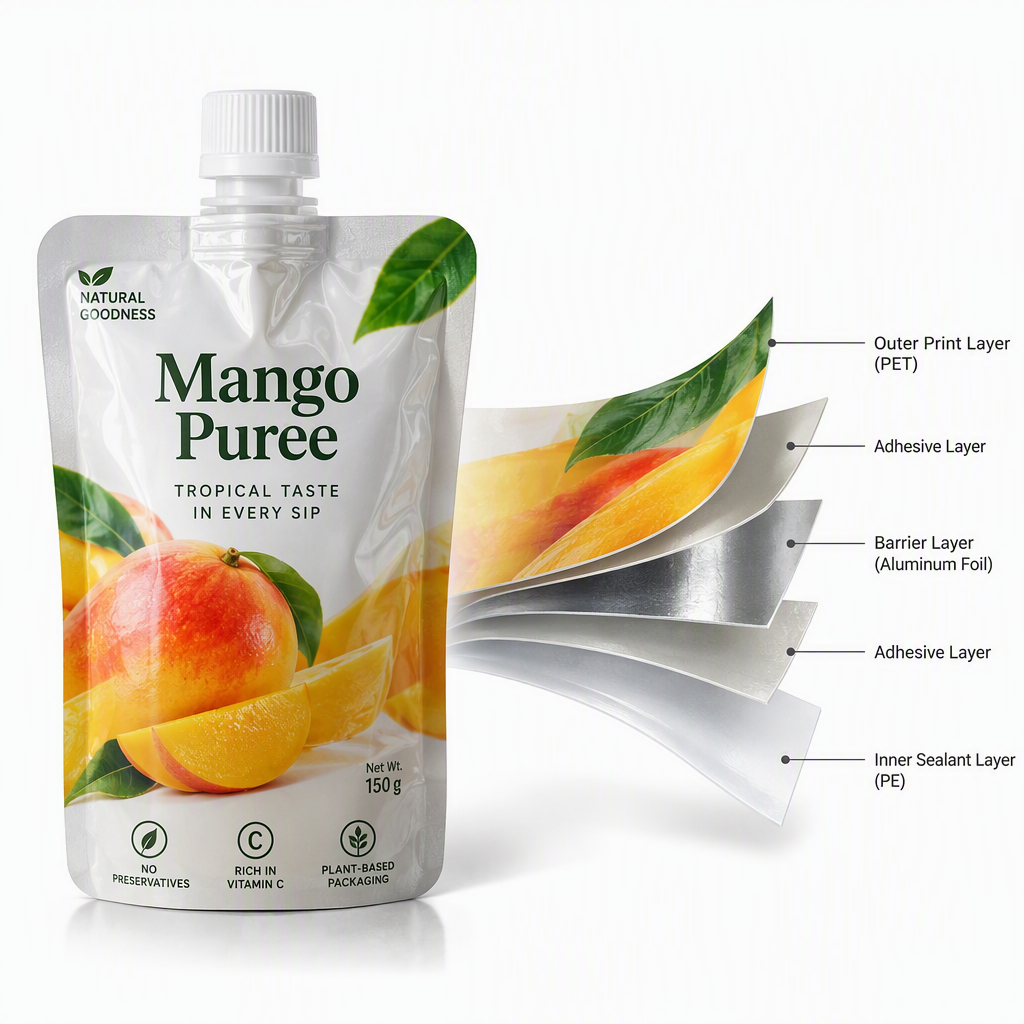
A laminated beverage pouch normally combines functional layers rather than relying on one film. An outer layer can provide printability and stiffness, a middle layer can contribute oxygen, moisture, light, or puncture protection, and the inner sealant layer contacts the beverage and forms the pouch seals.
- PET: commonly considered for print quality, stiffness, and dimensional stability.
- Nylon: may add puncture and flex resistance, but its moisture sensitivity must be considered in the full laminate.
- EVOH: can provide oxygen barrier when protected within an appropriate coextruded or laminated structure.
- Aluminum foil: provides very high light and gas barrier when intact, although flex-crack risk, opacity, and recovery options must be considered.
- PE or PP sealants: selected according to sealing process, product contact, thermal exposure, and fitment material.
Review the functions of PET, nylon, EVOH, and aluminum in spout pouch structures before naming a laminate. Buyers should request target oxygen and water-vapor transmission requirements when those values are known. A generic description such as “high barrier” is not a measurable specification.
For wine or alcohol-based drinks, conduct compatibility testing with the finished formulation. Ethanol, acids, flavor oils, colors, and preservatives can interact differently with sealants, adhesives, and fitment resins. Regulatory documentation should also be reviewed for the intended market and conditions of use.
Compare Ambient, Hot-Fill, and Aseptic Requirements
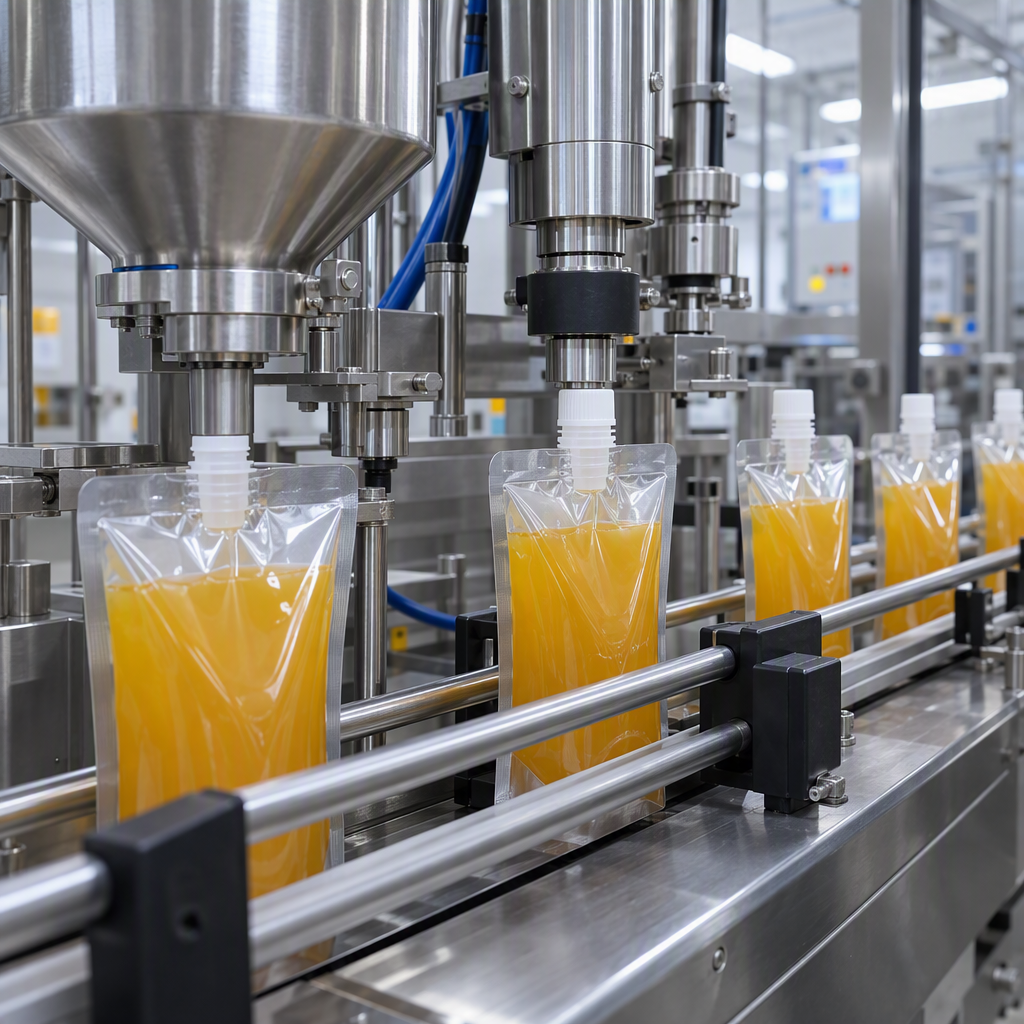
The filling and preservation process affects the film, sealant, spout resin, cap, and converting method. Specify the actual product temperature at filling rather than using “hot fill” as a general label.
| Process | Packaging implications | Buyer information required | Validation focus |
|---|---|---|---|
| Ambient or cold fill | May reduce thermal demands, but the product preservation system still determines barrier and hygiene needs | Fill temperature, sanitation process, preservatives if relevant, planned shelf life | Compatibility, seals, leakage, shelf life |
| Hot fill | Film, seals, fitment, and cap must tolerate the defined temperature and cooling cycle | Maximum product temperature, dwell time, inversion practice, cooling method | Distortion, seal integrity, fitment leakage, panel behavior |
| Aseptic fill | Packaging and fitment must be qualified for the filling line and sterilization method | Machine model, sterilization process, packaging feed format, fitment geometry | Sterility-related process qualification, seal integrity, line performance |
For thermally processed beverages, consult the detailed guide to hot-fill pouch films, seals, and validation. Final approval should be based on trials under the buyer’s production conditions.
Spout and Closure Specifications
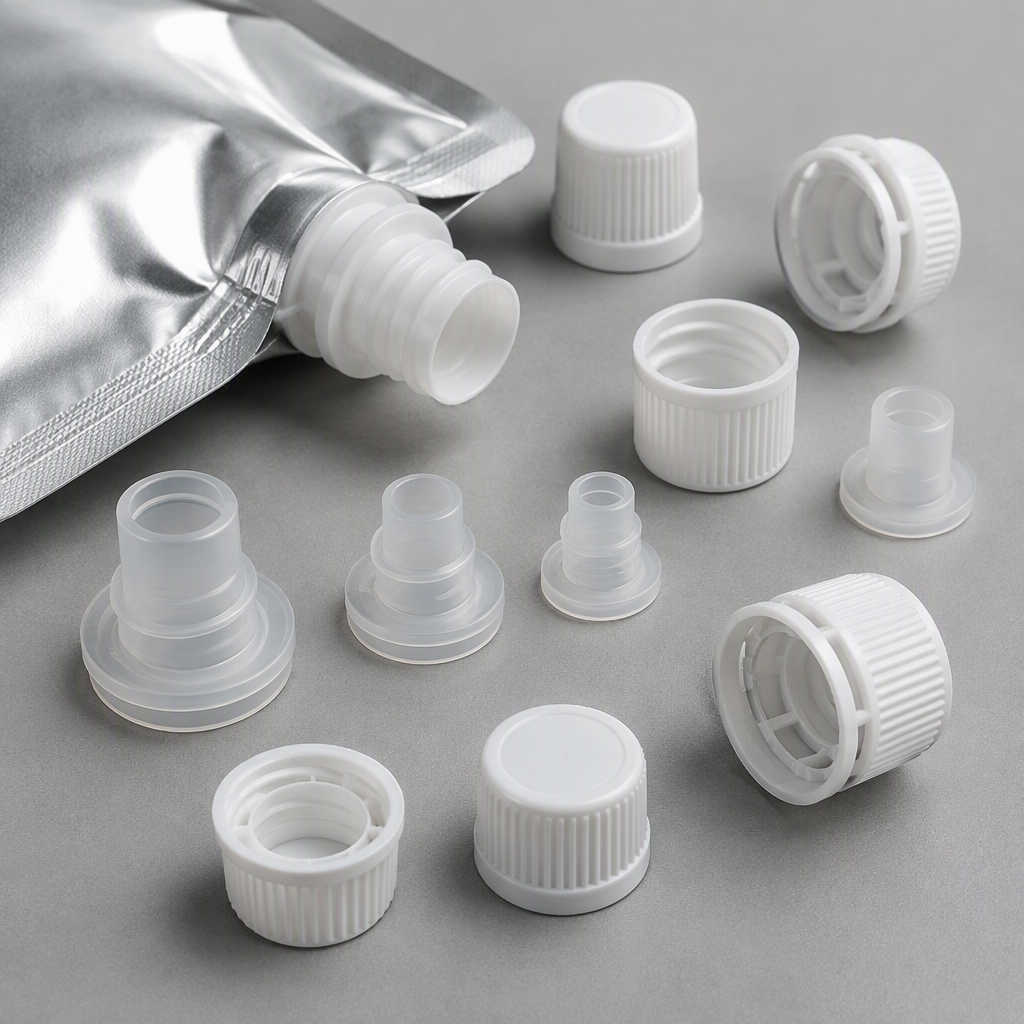
Spout selection begins with product flow and filling equipment. Record the fitment family, neck finish, inner bore, flange dimensions, cap style, cap application method, and tamper-evident feature. Avoid specifying only an approximate spout diameter because fitments with similar visible sizes may have different machine and sealing geometries.
Thin beverages can pour rapidly from a relatively small opening, while concentrates, pulp-containing juice, or products intended for quick decanting may require a larger flow path. The cap should provide the intended opening experience without compromising application torque or repeated closure. Review available caps, pumps, and beverage dispensing fitments as complete systems rather than interchangeable accessories.
Fitment resin must be compatible with the pouch sealant and filling temperature. The flange also needs sufficient clean sealing area. If product can contaminate the fitment-seal zone during filling, the filling and sealing process should be evaluated for channel leaks.
Pouch Format, Capacity, and Usable Volume
Common configurations include stand-up pouches for retail presentation, flat pouches for compact distribution, and larger handled formats for foodservice or multi-serve use. Size must be determined from usable volume, not nominal external dimensions alone.
Ask the converter to account for the bottom gusset, side seals, spout location, headspace, and the volume displaced by sealing. Confirm whether the requested capacity means net contents, maximum overflow volume, or a target fill volume with operational headspace. The pouch should remain stable at the intended fill level if shelf display is required.
Spout position also affects evacuation and pouring. A corner spout can support directional pouring, while a top-centered spout may suit certain filling or dispensing systems. Handles, rounded corners, tear notches, and hang holes should be included only when they serve the package use and do not interfere with filling, sealing, or secondary packing.
Testing and Validation Before Production

A beverage pouch should be evaluated as a complete system containing the actual product. The test plan should reflect the filling process, shelf-life target, transport route, storage orientation, and anticipated consumer handling.
- Product compatibility: inspect for swelling, delamination, brittleness, discoloration, odor transfer, flavor change, and fitment effects.
- Seal and leak integrity: evaluate pouch perimeter seals, spout-flange seals, and cap sealing under defined methods.
- Distribution performance: conduct drop, compression, vibration, carton, and pallet trials appropriate to the shipping route.
- Barrier and shelf life: assess sensory, chemical, and microbiological criteria defined by the beverage producer.
- Opening and dispensing: check cap removal, tamper evidence, pouring control, reclosure, and product evacuation.
- Line trials: verify pouch feeding, fitment handling, filling accuracy, cap application, sealing, and coding.
Machine compatibility should be confirmed against technical drawings and samples. The spout pouch filling-line fitment guide explains the machine dimensions buyers should compare. Test methods, sample quantities, conditioning, acceptance criteria, and responsibility for approval should be agreed before mass production.
Beverage Spout Pouch RFQ Checklist
Include the following information in a beverage pouch request for quotation:
- Beverage name, formulation category, pH, alcohol content, viscosity, and suspended solids where relevant.
- Required net volume, target fill volume, headspace, and dimensional limits.
- Ambient, chilled, frozen, hot-fill, or aseptic conditions, including exact temperatures.
- Required shelf life, storage environment, and known oxygen or light sensitivities.
- Preferred pouch format, spout position, fitment drawing, cap, and tamper evidence.
- Filling-machine make, model, operating direction, pouch feed method, and target speed.
- Print process, artwork count, colors, finish, coding area, and registration requirements.
- Testing, inspection, food-contact documentation, and destination-market requirements.
- SKU quantities, forecast volume, order frequency, packing method, and delivery destination.
When comparing manufacturers, assess technical review, sample control, quality documentation, fitment sourcing, and change management—not price alone. A structured spout pouch supplier evaluation can help buyers compare quotations on the same basis.
Samples, Artwork, and Order Planning
Approve function before committing to printed production. Start with available material or fitment samples when possible, then progress to a dimensionally representative prototype and a filling-line trial. Printed samples may require different preparation, cost, and lead time than unprinted test pouches.
For artwork, confirm the dieline version, print process, color references, varnish or matte areas, eye marks, barcode location, coding zone, and areas distorted by the gusset or spout. Keep separate approval records for structure, dimensions, fitment, artwork, and packing.
Commercial quotations should identify pouch construction, dimensions, fitment and cap references, printing assumptions, quantity by SKU, packing method, tooling or cylinder charges where applicable, sample scope, and agreed inspection criteria. This reduces the risk of comparing technically different beverage pouches under the same unit description.
FAQ
What barrier does a wine spout pouch need?
The required barrier depends on the wine, target shelf life, package size, light exposure, storage conditions, closure, and distribution route. Oxygen and light protection are common priorities, but buyers should establish measurable requirements through shelf-life work rather than relying only on the term “high barrier.” The cap, fitment, seals, and pouch body must be evaluated together.
Can the same beverage spout pouch be used for wine and juice?
Not automatically. Wine and juice can differ in alcohol content, acidity, aromas, preservation process, fill temperature, and oxygen sensitivity. A construction may be screened for both applications, but compatibility and shelf-life testing should use each finished product.
Can carbonated beverages be packed in spout pouches?
Carbonation creates internal pressure that can stress the pouch body, seals, fitment, and cap. Conventional non-carbonated beverage pouches should not be assumed suitable. The package requires pressure-specific engineering, controlled filling trials, temperature conditioning, and distribution validation.
What spout size is best for a beverage pouch?
There is no universal best size. Select the fitment bore from beverage viscosity, pulp or particles, desired pour rate, filling method, cap format, and machine interface. Approve the final fitment by drawing number and physical sample rather than nominal diameter alone.
Does a hot-filled beverage require a different pouch?
Usually, the thermal process changes the specification. Film layers, adhesives, sealant, spout resin, cap, seals, and pouch geometry must tolerate the defined filling temperature and cooling cycle. Validation must use the actual maximum temperature, dwell time, and handling procedure.
How should buyers confirm beverage pouch capacity?
Define net contents, target fill volume, required headspace, and maximum package dimensions. Request a volume drawing or representative samples, fill them with the product or a suitable test liquid, and confirm stability, sealing clearance, pouring, and secondary-pack fit.
What should be tested before ordering printed beverage pouches?
Test formulation compatibility, shelf life, seal integrity, leakage, filling-line handling, cap application, opening, reclosure, dispensing, drop performance, carton packing, and transport conditions. Printed production should begin only after the responsible parties approve the structure, dimensions, fitment, and test criteria.
Discuss Your Beverage Pouch Requirements
Share your beverage formulation, pouch structure needs, spout fitment, filling process, artwork, expected quantity, sample requirements, and quotation details with HUACANG Packaging for a technical review.