Table of Contents
- What Determines Spout Pouch Shelf Life?
- Identify the Product's Deterioration Pathways
- Understand OTR and WVTR
- Compare Common Barrier Materials
- Match the Barrier to the Product
- Evaluate the Complete Pouch System
- Build a Pouch Shelf-Life Testing Plan
- Use Accelerated Testing Carefully
- What Buyers Should Specify
Spout pouch shelf life depends on the filled product, film barrier, seals, spout and cap system, filling process, storage environment, and distribution conditions. This guide explains how buyers can compare barrier specifications and build a practical shelf-life testing plan.
What Determines Spout Pouch Shelf Life?
Spout pouch shelf life is determined by how well the complete filled package controls the product’s relevant deterioration mechanisms throughout processing, storage, and distribution. Film barrier is important, but it is only one part of the result. Seal integrity, spout and cap performance, product chemistry, initial oxygen, filling conditions, light exposure, temperature, humidity, and handling can all change the usable life of the product.
There is therefore no universal shelf-life value for a particular laminate. A structure that works for an acidic sauce may be unsuitable for an oxidation-sensitive oil, even when both products use the same pouch size. The defensible way to establish shelf life is to define the product’s failure criteria, select a technically appropriate package, and test the actual filled package under representative conditions.
Buyers should treat film data as screening information rather than a finished-package guarantee. Oxygen transmission rate, water vapor transmission rate, and light barrier can help narrow the options, but commercial shelf life must be supported by product-specific testing.
Identify the Product's Deterioration Pathways

Start with the product, not a preferred film structure. The formulation owner should identify what makes the product unacceptable and how that change will be measured. A package can remain leak-free while the contents lose flavor, change color, separate, absorb moisture, or fall outside a microbiological specification.
- Oxidation: Oxygen can contribute to rancidity, color change, vitamin loss, aroma deterioration, and other chemical changes. Oils, fatty foods, selected sauces, and products with oxidation-sensitive flavors may require an oxygen barrier pouch.
- Moisture gain or loss: Water vapor transfer can alter concentration, viscosity, texture, or product weight. Water vapor barrier packaging may be important for moisture-sensitive concentrates and products stored in dry or humid environments.
- Light exposure: Visible or ultraviolet light can affect certain colors, oils, vitamins, fragrances, and flavors. Transparent structures allow product visibility but may not suit light-sensitive formulations.
- Microbiological change: Packaging does not replace an adequate preservation or thermal process. Product pH, water activity, preservatives, hygiene, processing, and closure integrity must be considered together.
- Package interaction: Flavor scalping, aroma transfer, staining, swelling, delamination, stress cracking, or sealant incompatibility can make a technically high-barrier structure unsuitable.
Define measurable end points before testing. Examples include sensory acceptance, color, viscosity, peroxide value, nutrient retention, weight change, microbial limits, seal condition, or dispensing performance. The appropriate criteria depend on the formulation and applicable market requirements.
Understand OTR and WVTR
OTR and WVTR are the two barrier measurements most often reviewed during preliminary material selection. Both values must be read with their test conditions, units, specimen construction, and test method. A number without this context is not suitable for comparing structures.
Oxygen transmission rate (OTR) reports how much oxygen passes through a defined area of material over time. It is commonly expressed as cubic centimeters per square meter per day. Temperature, relative humidity, oxygen concentration, and the condition of the test specimen can affect the result. Lower values indicate less oxygen transmission under the stated conditions.
Water vapor transmission rate (WVTR) reports how much water vapor passes through a defined area over time, commonly in grams per square meter per day. The result also depends on specified temperature and humidity conditions. Lower values indicate less water vapor transmission under those conditions.
OTR and WVTR are normally film-level measurements. They do not automatically include transmission through the spout, cap, seal interfaces, or microscopic damage caused during converting and handling. The ratio of package surface area to product volume also matters: the same laminate can produce different shelf-life outcomes in a small pouch and a large pouch.
Compare Common Barrier Materials
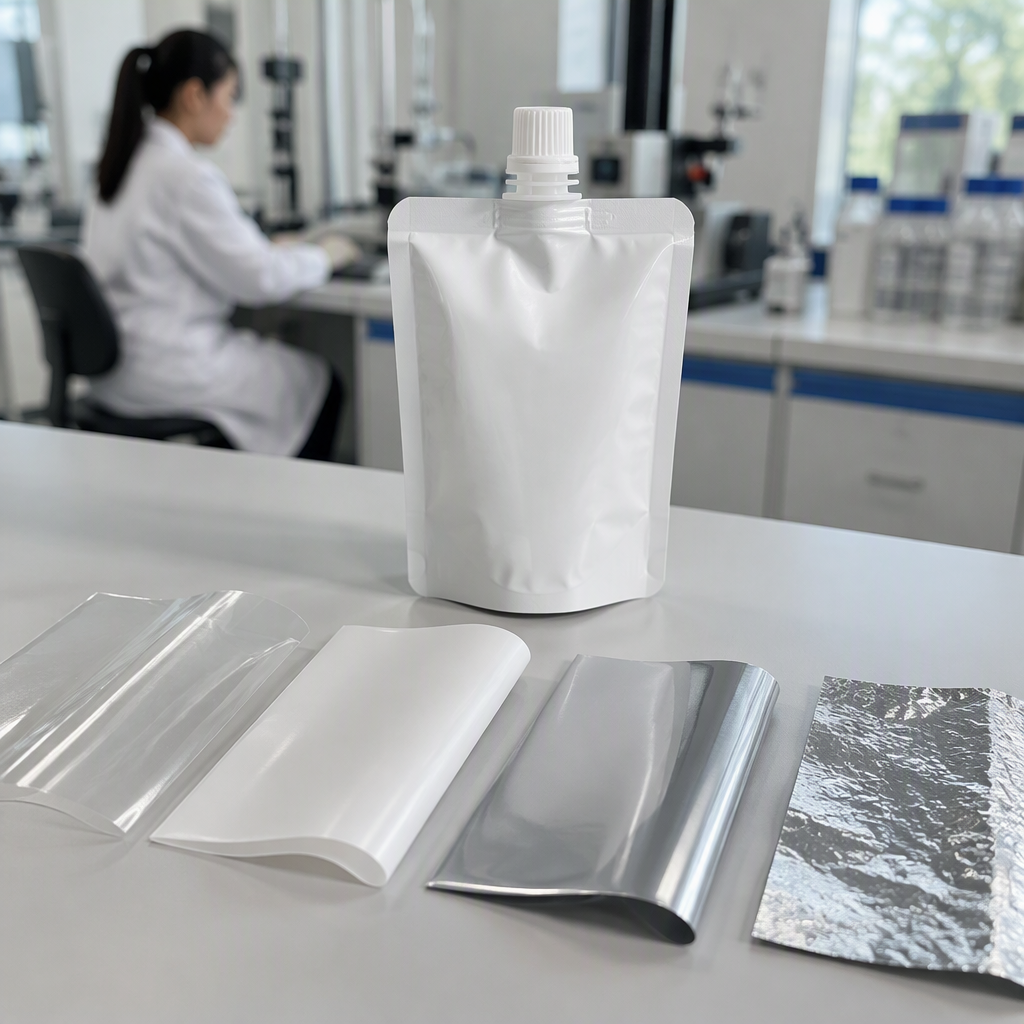
A spout pouch laminate combines layers because no single material provides every required property. The actual performance depends on resin grade, thickness, adhesives, orientation, coating quality, converting conditions, and exposure to heat and humidity. Buyers can use the following comparison for initial screening, then request structure-specific test data.
| Material or layer | Typical function | Barrier considerations | Selection cautions |
|---|---|---|---|
| PET | Print surface, stiffness, dimensional stability | Provides some gas and moisture resistance but is not normally selected alone for demanding oxygen barrier | Must be combined with a suitable sealant layer; structure performance depends on total laminate |
| PA or nylon | Toughness, puncture resistance, flex resistance | Can contribute to gas barrier, but moisture can affect performance | Not a substitute for a dedicated high-barrier layer where low OTR is required |
| EVOH | Oxygen barrier | Can provide low oxygen transmission when protected within a multilayer structure | Barrier is sensitive to moisture and must be evaluated at relevant humidity and process conditions |
| Aluminum foil | High gas, moisture, and light barrier | Offers very strong barrier when the foil remains intact | Opaque; flex cracking, pinholes, folds, and seal-area design must be controlled |
| Metallized film | Enhanced gas, moisture, and light barrier | Performance depends on coating continuity and handling | Not equivalent to aluminum foil; metal coverage and flex damage can affect results |
| PE or PP sealant | Heat sealing and product-contact layer | Usually contributes moisture resistance but limited oxygen barrier by itself | Resin selection must match product, sealing process, filling temperature, and fitment material |
For a deeper review of layer functions and tradeoffs, see HUACANG Packaging’s guide to PET, nylon, EVOH, and aluminum spout pouch materials.
Match the Barrier to the Product
The following product table is a screening tool, not a shelf-life claim or final laminate specification. Final selection requires formulation details, processing information, distribution conditions, and filled-package testing.
| Product situation | Primary risks to investigate | Initial package questions | Testing priorities |
|---|---|---|---|
| Oil or fat-containing product | Oxidation, light exposure, flavor change | Is low OTR required? Must the structure block light? How much oxygen remains after filling? | Oxidation markers, sensory quality, color, closure integrity |
| Acidic sauce or condiment | Color or flavor change, seal contamination, package interaction | What are the pH, viscosity, particulates, fill temperature, and preservation process? | Sensory and color checks, seal integrity, dispensing, microbial criteria |
| Water-based beverage or concentrate | Aroma loss, oxygen entry, moisture transfer, microbial stability | Is the product hot-filled, cold-filled, aseptically filled, or otherwise processed? | Flavor, nutrient or color markers where relevant, package integrity, weight change |
| Personal care refill | Fragrance transfer, stress cracking, swelling, leakage | Are surfactants, oils, alcohols, or fragrances compatible with the sealant and fitment? | Compatibility, mass change, appearance, seals, dispensing, closure torque |
| Household chemical | Material incompatibility, permeation, paneling or swelling, closure leakage | Has the formulation been reviewed for film, adhesive, fitment, liner, and ink compatibility? | Compatibility under intended storage, upright and side storage, package integrity |
| Thermally processed food | Process damage, seal deformation, delamination, post-process barrier loss | What validated time-temperature process must the package withstand? | Thermal-process validation, seal and laminate condition, barrier after processing, product criteria |
For viscous foods, the barrier decision should be coordinated with filling and dispensing requirements. The guide to sauce pouch viscosity and dispensing explains the related effects of particulates, spout bore, and product flow.
Evaluate the Complete Pouch System

A high-barrier laminate cannot compensate for an unsuitable fitment or an unreliable seal. The film, seals, spout, cap, liner if used, and filling process form one package system.
Spout and closure
Gas or moisture can enter through the fitment resin, cap interface, tamper-evident features, or an imperfectly seated closure. Spout geometry also affects filling, product evacuation, and the amount of product left in the package. Confirm material compatibility, bore size, cap type, application torque, tamper evidence, and whether induction sealing or another secondary seal is required. HUACANG Packaging’s overview of spout pouch fitments, caps, pumps, and dispensers covers these decisions in more detail.
Heat seals and spout welds
Shelf-life samples should represent commercial manufacturing settings. Channel leaks, wrinkles, product contamination in the seal area, weak spout welds, and cap leakage can invalidate barrier assumptions. Package integrity testing should cover the pouch perimeter, bottom gusset, spout interface, and closure. Relevant methods and limitations are described in the guide to spout pouch leak testing.
Processing and headspace
Hot filling, retorting, cooling, or other processing can alter the film, adhesives, seals, and fitments. Residual headspace oxygen may also be important for an oxidation-sensitive product; a low film OTR does not remove oxygen already introduced during mixing or filling. For thermally filled products, review the complete hot-fill pouch film, seal, and validation process.
Build a Pouch Shelf-Life Testing Plan

A useful pouch shelf life testing plan is written before samples enter storage. It identifies the test product, package configuration, controls, storage conditions, sampling intervals, measurements, acceptance criteria, and responsibility for reviewing results.
- Define the claim and assumptions. State the desired unopened shelf life, intended markets, storage statement, expected temperature and humidity range, light exposure, and distribution route. If refrigerated storage is required, define the target range and foreseeable excursions.
- Establish a baseline. Record product measurements immediately after filling, including relevant chemical, physical, sensory, and microbiological data. Document fill weight, headspace, closure application, coding, and package dimensions.
- Use production-representative samples. Ideally, samples should use the intended film structure, print or ink coverage where relevant, pouch geometry, fitment, cap, filling equipment, sealing parameters, and post-fill process. Hand-filled prototypes can identify compatibility issues but may not reproduce commercial headspace and seal conditions.
- Include appropriate controls. Controls may include the current package, a higher-barrier reference, an unfilled package for physical observations, or an alternative closure. Controls should answer a defined technical question.
- Test intended and challenge orientations. Upright storage reflects many retail conditions, while side or inverted storage can keep the product in continuous contact with the spout and seals. Use orientations consistent with foreseeable storage and transport.
- Set sampling intervals. Early intervals can identify rapid incompatibility. Later intervals should cover the proposed shelf life and, when appropriate, a margin beyond it. The schedule should account for the product’s expected rate of change.
- Assess package and product together. Check appearance, delamination, swelling, paneling, cracking, discoloration, odor transfer, leakage, cap retention, dispensing, seals, weight, and relevant product quality measures.
- Document lot and test details. Record film and fitment lots, converting date, filling date, equipment settings, storage chamber data, methods, deviations, and individual results. Retain samples when practical for investigation.
Distribution testing and package integrity tests complement shelf-life work but do not replace it. A package may survive a drop test yet provide insufficient oxygen barrier, or meet film barrier requirements but leak after repeated flexing.
Use Accelerated Testing Carefully
Accelerated testing exposes filled packages to elevated temperature, humidity, light, or another controlled stress to obtain earlier evidence of change. It can help compare structures, identify incompatibility, or prioritize options before real-time data are complete. It does not automatically establish a commercial expiration date.
Acceleration is valid only when the elevated condition produces the same relevant deterioration mechanism as normal storage. Excessive heat may soften sealants, change product viscosity, distort fitments, accelerate reactions differently, or create delamination that would not occur under intended conditions. High humidity can disproportionately affect moisture-sensitive barrier layers. A simple statement that a certain number of hot-storage days equals a fixed number of ambient months is not defensible without a validated model for that formulation and package.
Run real-time studies under the labeled storage condition whenever shelf life is commercially or technically important. Accelerated and real-time programs can proceed in parallel: accelerated results support early decisions, while real-time results confirm performance. Where temperature-based modeling is used, the product owner should define the kinetic model, analytical marker, assumptions, and limits with qualified technical support.
What Buyers Should Specify
A packaging inquiry should provide enough information for the converter to recommend testable options. Avoid requesting only a generic material name or an unsupported shelf-life target.
- Product type, ingredients relevant to compatibility, pH where applicable, viscosity, particulates, oils, alcohols, surfactants, or fragrances
- Target fill volume, fill weight, pouch dimensions, and acceptable headspace
- Filling method, fill temperature, sealing method, cooling process, and line speed
- Any hot-fill, pasteurization, retort, aseptic, freezing, or refrigerated-storage requirements
- Target unopened shelf life and conditions under which that shelf life must be achieved
- Required OTR, WVTR, or light barrier, including test method, units, temperature, and humidity when these values are known
- Spout position, bore, fitment resin, cap style, tamper evidence, and closure application requirements
- Distribution route, case pack, pallet pattern, expected altitude, handling risks, and storage orientation
- Artwork, viewing window, opacity, print process, surface finish, and coding requirements
- Regulatory and documentation requirements for the destination market and intended product use
Before shipment, agreed specifications and test records should be checked against approved samples and purchase documents. The spout pouch pre-shipment inspection checklist outlines practical dimensional, visual, functional, and documentation checks for B2B orders.
FAQ
How long does a product last in a spout pouch?
There is no standard shelf life for all products or spout pouches. The result depends on formulation, processing, initial product quality, film barrier, package size, spout and cap, seal integrity, storage, and distribution. Establish the period through testing of the actual product in a production-representative package.
Does a lower OTR always produce a longer shelf life?
No. Lower OTR reduces oxygen transmission under the stated test conditions, but oxygen may not be the limiting factor. Moisture, light, temperature, microorganisms, package interaction, seal leakage, fitment transmission, or oxygen introduced during filling may control product life instead.
What is the difference between OTR and WVTR?
OTR measures oxygen transmission through a material, while WVTR measures water vapor transmission. Both results depend on the test method and conditions, including temperature and humidity. Values should only be compared when units and test conditions are equivalent.
Can film barrier data predict finished spout pouch shelf life?
Film data can support material screening and package modeling, but it does not account fully for seals, spout and cap transmission, headspace oxygen, processing damage, package geometry, storage, or product reactions. Finished-package testing is required to support a shelf-life decision.
Is aluminum foil always required for an oxygen barrier pouch?
No. Aluminum foil is one high-barrier option, but EVOH, coated films, metallized films, and other multilayer structures may be considered depending on the required barrier, visibility, processing, flex resistance, economics, and disposal objectives. The choice should be based on measured structure performance and filled-product testing.
Should shelf-life samples be stored upright or on their side?
Use orientations that represent foreseeable storage and transport. Upright storage may reflect retail presentation, while side or inverted storage challenges the spout, cap, and seal areas through continuous product contact. The protocol may include more than one orientation when leakage or compatibility is a concern.
Can accelerated testing replace real-time testing?
Accelerated testing can screen structures and identify early problems, but it should not be treated as a substitute for real-time testing unless the acceleration model has been validated for the specific product, package, failure mechanism, and conditions. Running accelerated and real-time studies in parallel is often the more useful approach.
Who is responsible for validating liquid product shelf life?
The product owner is generally responsible for defining product acceptance criteria and supporting the labeled shelf life. Packaging manufacturers can supply material specifications, samples, test data, and manufacturing information, but they cannot determine product stability without the formulation, filling process, storage conditions, and product-specific results.
Discuss Your Spout Pouch Shelf-Life Requirements
Share your product, processing method, target shelf life, storage conditions, and distribution needs with HUACANG Packaging. Our team can discuss candidate pouch structures, spout fitment, artwork, MOQ, samples, and the information needed for a quote and validation plan.