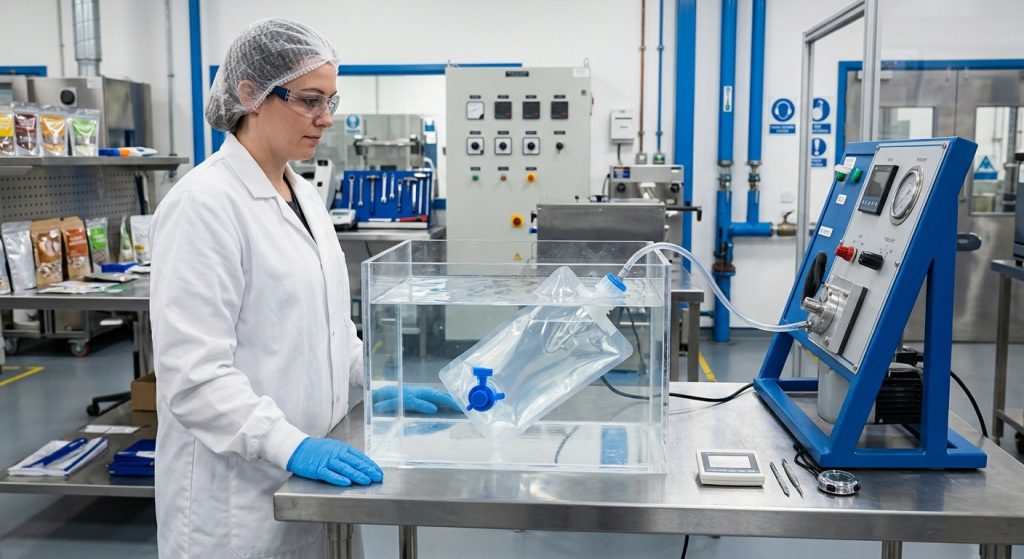
Table of Contents
- What Spout Pouch Leak Testing Verifies
- Common Leak Failure Points
- Spout Pouch Leak Test Methods
- Relevant Standards and Test Methods
- How to Build a Testing Plan
- How Buyers Should Review Results
Spout pouch leak testing verifies that the pouch film, heat seals, spout attachment, cap, and filled package can withstand production, storage, and distribution conditions. This guide explains practical test methods, relevant ASTM standards, sampling considerations, and how to interpret results when sourcing custom spout pouches.
What Spout Pouch Leak Testing Verifies
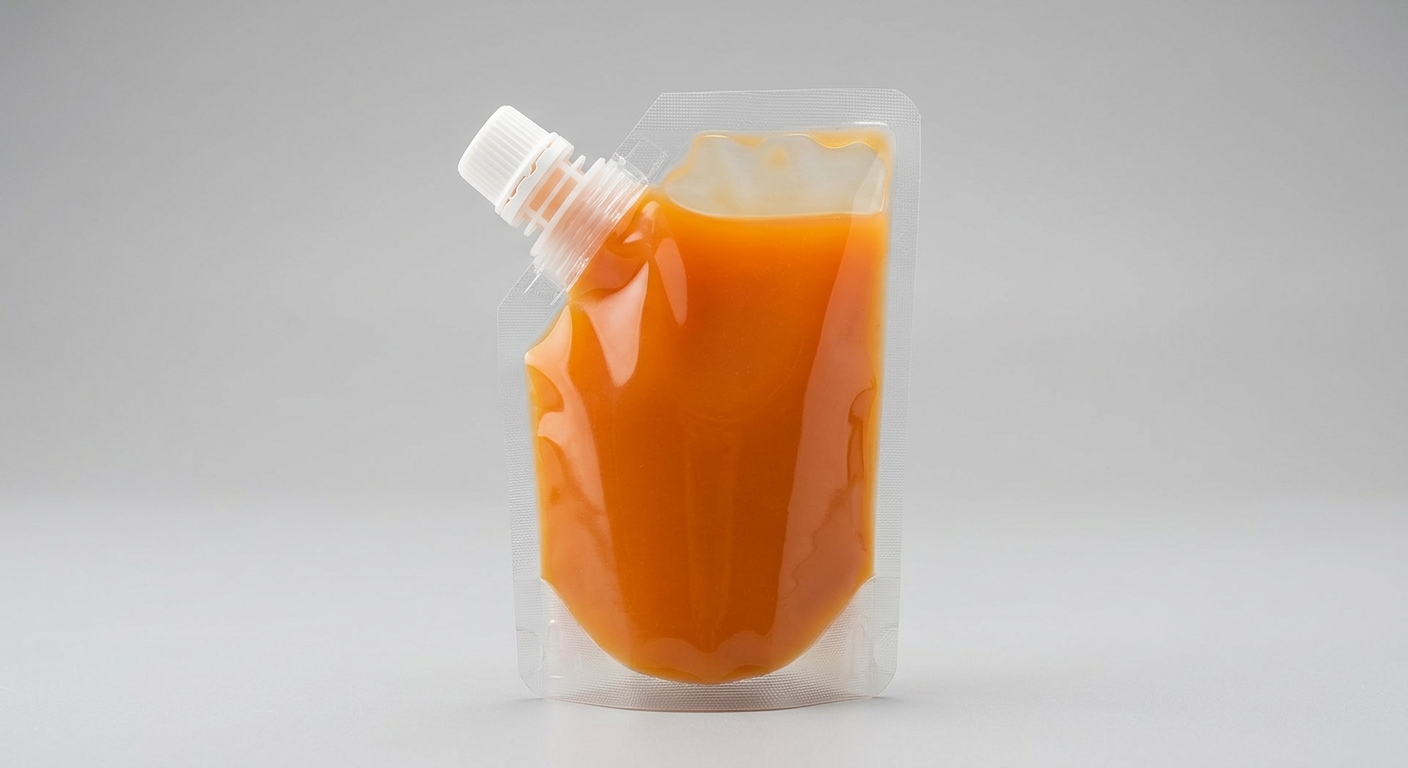
Spout pouch leak testing verifies whether a filled pouch and its dispensing fitment maintain package integrity under a defined test condition. The test should evaluate the complete package system—not only the flexible film. This normally includes the laminate, pouch seals, spout-to-film seal, spout body, cap or closure, and any opening feature.
A suitable test plan helps answer three different questions:
- Does the package leak now? This is a short-term integrity check for samples or production lots.
- Where could leakage begin? Seal strength, burst, and visual inspection can identify weak areas before distribution.
- Will the package remain intact in its intended use? Filled-package testing, transport simulation, temperature conditioning, and shelf-life work provide broader validation.
Leak testing does not replace compatibility, migration, shelf-life, or distribution testing. It is one part of a package validation program, and the acceptance criteria should be linked to the product, filling process, storage conditions, and distribution route.
Common Leak Failure Points
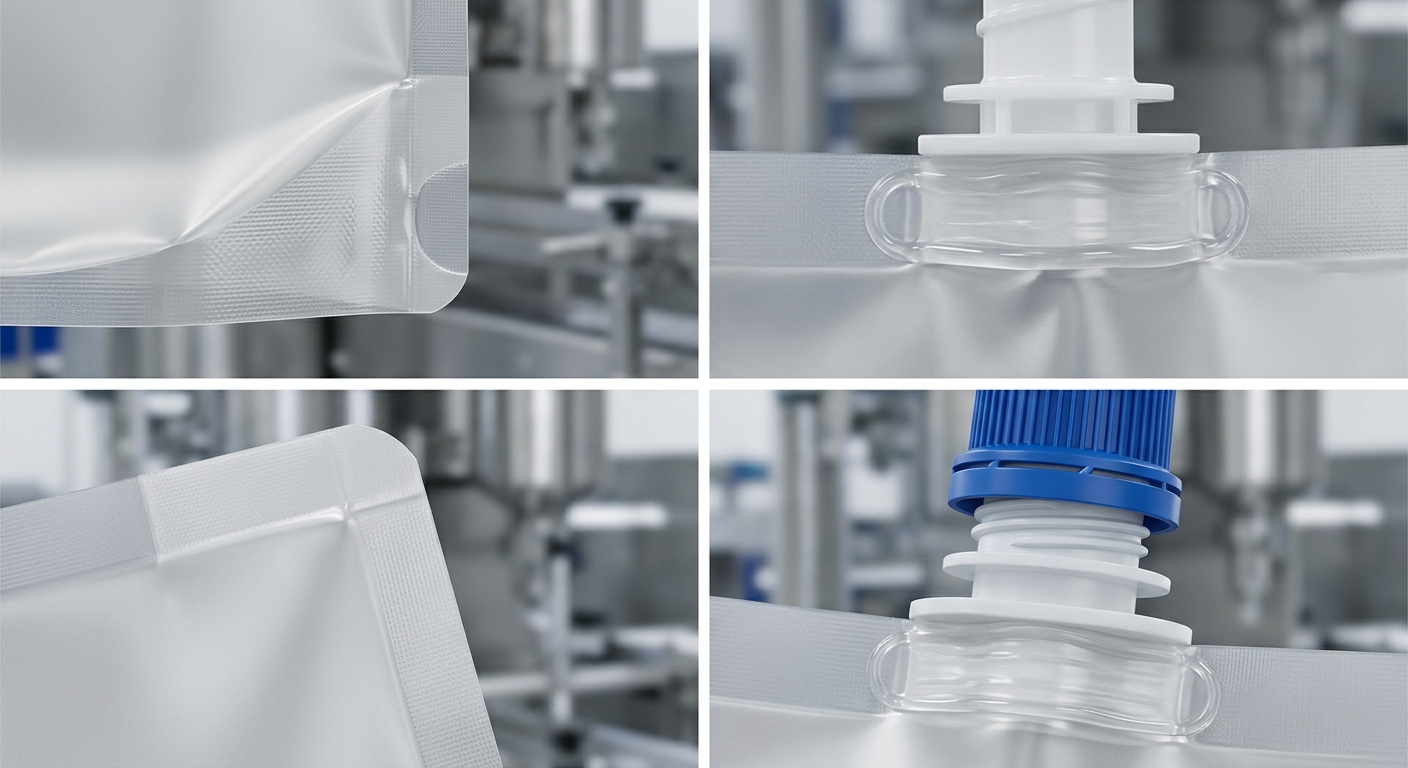
Most failures occur at a transition between materials, components, or process steps. A pouch can have strong film seals and still leak through the fitment area or closure. Buyers should therefore inspect and test each potential path.
- Side and bottom seals: Contamination, inadequate heat, insufficient pressure, excessive speed, or incompatible sealant layers can reduce seal integrity.
- Spout-to-film attachment: The fitment seal may be affected by fitment geometry, laminate construction, sealing temperature, dwell time, and product trapped in the seal area.
- Cap and neck interface: Cross-threading, damaged threads, poor torque control, cap deformation, or a mismatched closure can create leakage after filling.
- Film damage: Punctures, pinholes, creases, sharp edges, and handling damage may not be visible without a suitable test.
- Opening feature: Tear notches, laser scores, easy-open seals, or tamper-evident structures must remain closed before intended opening.
- Product-related stress: Oils, solvents, acids, surfactants, alcohol, heat, or frozen conditions may change seal performance or film flexibility.
Test samples should represent the actual production structure and fitment. A laboratory pouch made with different film, spout resin, dimensions, or sealing settings may not predict production performance.
Spout Pouch Leak Test Methods
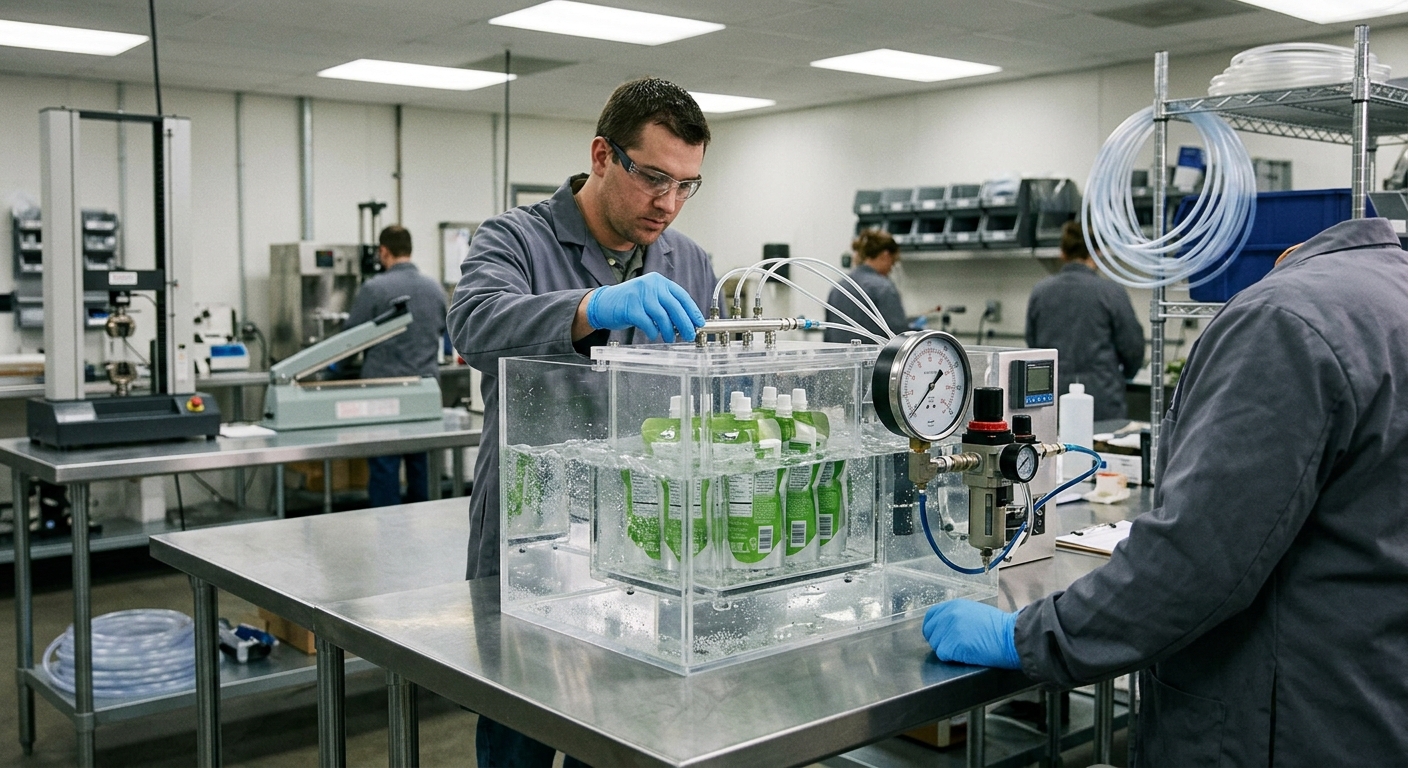
No single method detects every defect. The most useful approach combines a fast screening method with a quantitative or targeted test for the suspected failure mode.
Visual inspection and manual examination
Inspect unfilled and filled pouches for wrinkles across seals, incomplete seals, burn-through, channels, contamination, punctures, cap damage, and misaligned fitments. Gently examine the pouch and closure for obvious seepage. This method is inexpensive but cannot reliably detect small leaks or establish a pressure threshold.
Submersion or bubble-emission testing
A filled or pressurized package is submerged in water while the operator observes for a continuous stream of bubbles. The package may be squeezed or internally pressurized according to the procedure. This method is practical for locating leaks, but results depend on package preparation, pressure, immersion time, water temperature, operator observation, and the size and location of the defect.
Vacuum chamber testing
The package is placed in a chamber, and a controlled vacuum is applied. Leakage may be indicated by bubbles in a liquid bath, pressure change, or visible package behavior, depending on the equipment. Vacuum testing can provide repeatable screening when the method is validated for the pouch format. A flexible pouch may deform under vacuum, so fixture design and test settings matter.
Pressure decay or vacuum decay
Pressure-decay and vacuum-decay systems measure a change in pressure over a specified period. They can support non-destructive, automated inspection, but the correct sensitivity depends on package volume, temperature, material flexibility, test time, and fixture sealing. A system must be calibrated and correlated with known defects or reference leaks.
Burst and creep testing
Burst testing increases internal pressure until the package or seal fails. Creep testing holds a package at a defined load or pressure for a period. These tests evaluate resistance to severe stress and can reveal weak seals, but they are destructive and should not be treated as a direct substitute for routine leak screening.
Seal strength testing
Seal strength testing measures the force required to separate a cut seal specimen. It helps compare sealing conditions and identify weak or inconsistent seals. A high seal-strength value alone does not prove that a finished pouch is leak-free; channels, contamination, pinholes, fitment defects, and closure problems may still be present.
Relevant Standards and Test Methods

Standards provide a common test framework, but they do not automatically define an acceptable result for every spout pouch. The buyer, converter, filler, and end user should agree on the applicable method, sample condition, equipment, test duration, and acceptance criteria.
| Method or standard | What it helps evaluate | Important consideration for spout pouches |
|---|---|---|
| ASTM D3078 | Leak detection by bubble emission for flexible packages | Useful for flexible package screening; define how the fitment and cap are positioned and pressurized. |
| ASTM F2096 | Gross leak detection by internal pressurization and bubble emission | Typically applied to flexible packages; confirm that the package geometry and test pressure are suitable. |
| ASTM F2338 | Non-destructive leak detection using vacuum decay | Equipment and fixtures must account for pouch flexibility, volume, and temperature. |
| ASTM F88/F88M | Seal strength of flexible barrier materials | Use for pouch seals and, where appropriate, fitment seals; it is not a complete-package leak test. |
| ASTM F1140/F1140M | Internal pressurization resistance of flexible packages | Can support burst or creep evaluation; define whether failure at the film seal or fitment is being studied. |
| ASTM D4169 | Distribution-cycle practices for shipping containers and systems | Use as part of a distribution test plan, followed by leak and visual inspection of the pouches. |
Standards are periodically revised, and applicability can depend on package design. Buyers should obtain the current edition and confirm the method with their testing laboratory or quality team. Do not describe a pouch as “ASTM compliant” without naming the specific method, edition where relevant, test conditions, and result.
How to Build a Testing Plan

A practical testing plan begins with the real use case rather than a generic pass-or-fail request. Document the following before requesting samples or production testing:
- Product details: Identify viscosity, pH, oil or solvent content, particulate load, temperature at filling, and whether the product is food, personal care, household, agricultural, or industrial.
- Package configuration: Record pouch dimensions, nominal fill volume, laminate structure, thickness, spout material, opening diameter, cap type, and whether the pouch has a handle, zipper, or special shape.
- Process conditions: State filling temperature, fill speed, sealing equipment, cap application method, cap torque if controlled, and the expected time between filling and testing.
- Storage and distribution: Define upright or horizontal storage, temperature range, freezing or heat exposure, pallet configuration, transport mode, and expected handling.
- Test method: Select visual inspection, bubble emission, vacuum decay, pressure decay, burst, creep, seal strength, or a combination. Include conditioning time and test duration.
- Acceptance criteria: Specify whether any visible leakage is a failure, how many samples are required, and whether isolated cosmetic defects are treated differently from functional leaks.
- Traceability: Record production date, material batch, fitment batch, machine settings, sample quantity, operator, equipment identification, and results.
For development, test samples should include normal units and deliberately challenged units when possible. Known-defect samples help confirm that the selected method can detect the defect type that matters. For production, the inspection frequency and sampling level should be agreed in the quality specification rather than assumed after an issue occurs.
How Buyers Should Review Results

A useful test report should provide more than a statement that the pouches passed. Ask for the sample description, test method, equipment, conditioning, test pressure or vacuum, duration, sample quantity, observed failure location, and acceptance criteria. If a result is reported as “no leak,” clarify the method’s detection capability and whether the result applies to the complete pouch or only a cut seal specimen.
When failures occur, separate the failure location from the suspected cause. A leak at the bottom seal may require a process review, while leakage around the spout may require a fitment or sealing-window review. Cap leakage may involve application torque, thread damage, closure dimensions, or product contamination. Repeating the same test without recording these distinctions makes corrective action difficult.
Buyers should also compare results before and after conditioning. A pouch that passes immediately after filling may behave differently after heat exposure, freezing, stacking, vibration, or product contact. The correct conditions depend on the intended application, so avoid copying an acceptance limit from an unrelated product or package format.
Before approval, confirm that the tested structure, fitment, artwork substrate, dimensions, filling method, and closure match the commercial specification. Any change to film, sealant layer, spout resin, cap, filling temperature, or sealing equipment may require a risk review or repeat testing.