Table of Contents
- What OTR and WVTR Mean
- Why Barrier Properties Matter in Flexible Packaging
- How to Read OTR and WVTR Test Data
- Flexible Packaging Barrier Structure Comparison
- How to Specify Barrier Requirements in an RFQ
- How to Validate Packaging Shelf Life
- Key Takeaways for Packaging Buyers
OTR measures oxygen movement through packaging, while WVTR measures water vapor movement. This guide explains how to interpret both values, compare test conditions, and write practical barrier requirements for flexible packaging RFQs.
What OTR and WVTR Mean
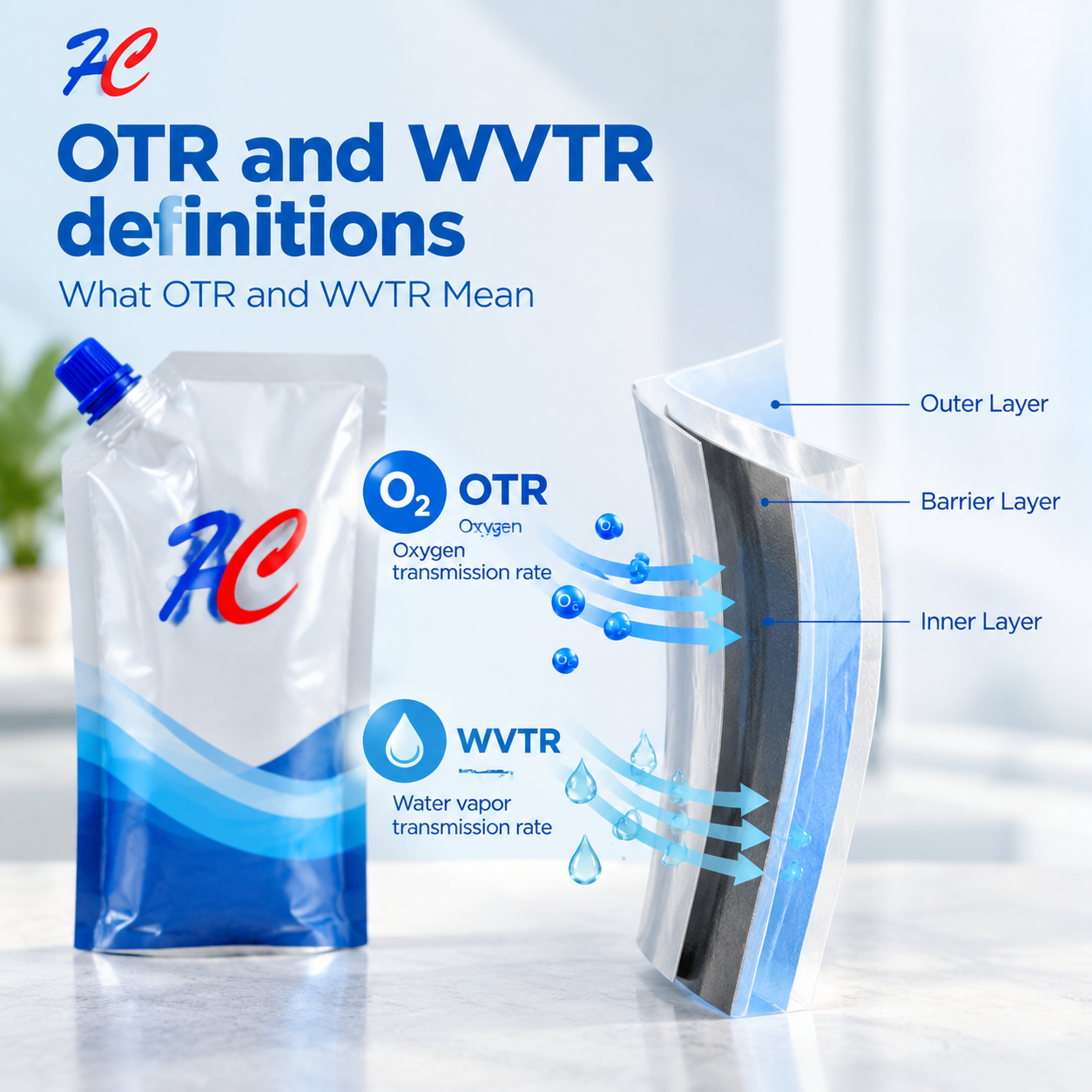
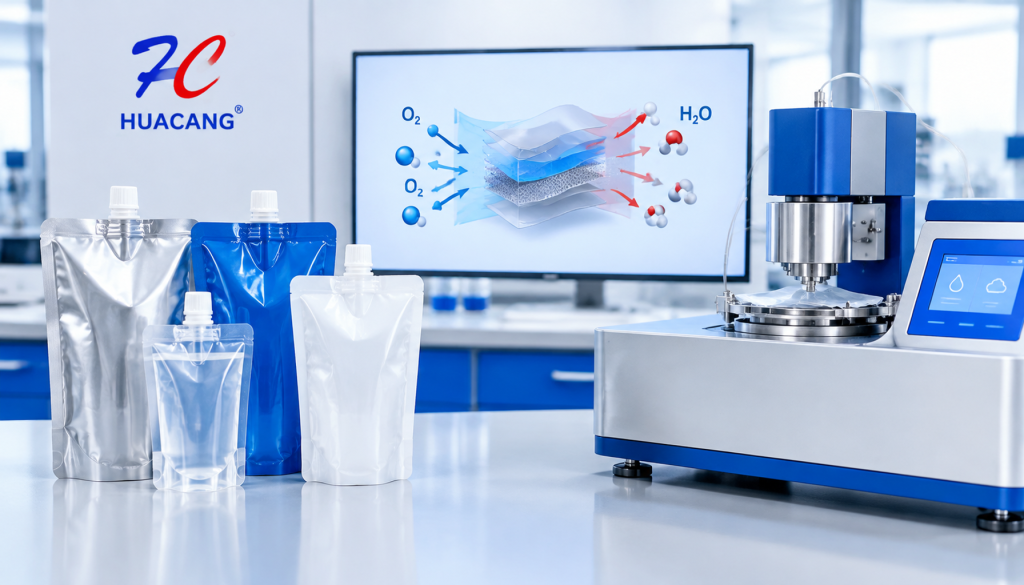
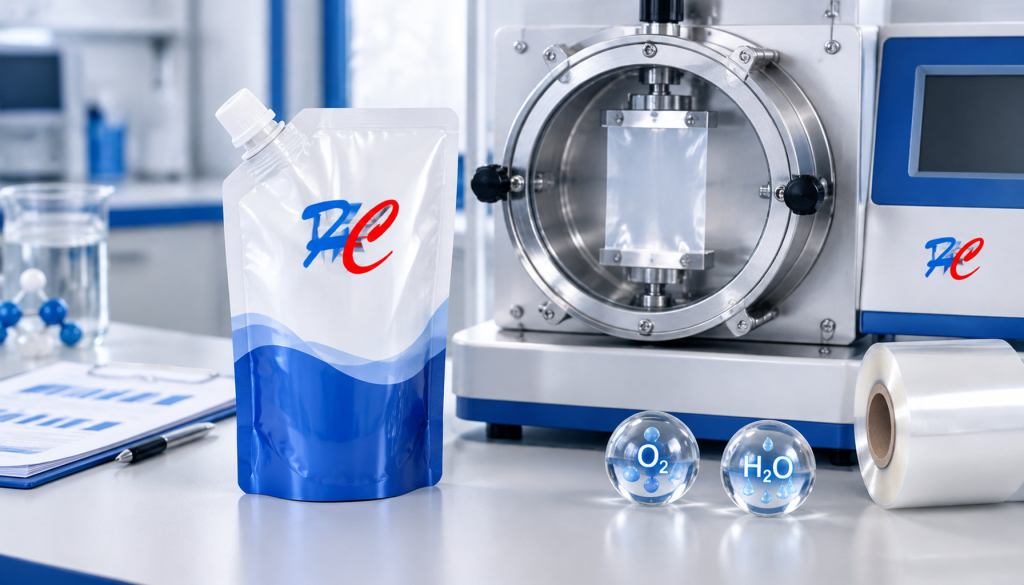
OTR and WVTR are two of the most important flexible packaging barrier properties. OTR, or oxygen transmission rate, measures how much oxygen passes through a film or finished package over a defined period. WVTR, or water vapor transmission rate, measures how much water vapor passes through it. Lower values generally indicate stronger resistance to the relevant gas or vapor, but a value is meaningful only when its test conditions and package construction are also known.
Quick definitions
- OTR: The quantity of oxygen transmitted through a specified area of packaging in a specified time, commonly reported as cc/(m²·day).
- WVTR: The quantity of water vapor transmitted through a specified area of packaging in a specified time, commonly reported as g/(m²·day).
- Barrier: The ability of a packaging material or package to limit the movement of oxygen, water vapor, aroma, light, or other substances.
These measurements are not interchangeable. A pouch may need low OTR to protect oxygen-sensitive coffee, snacks, or sauces, while a dry powder may be especially sensitive to moisture and therefore require low WVTR. Many products need both.
Why Barrier Properties Matter in Flexible Packaging
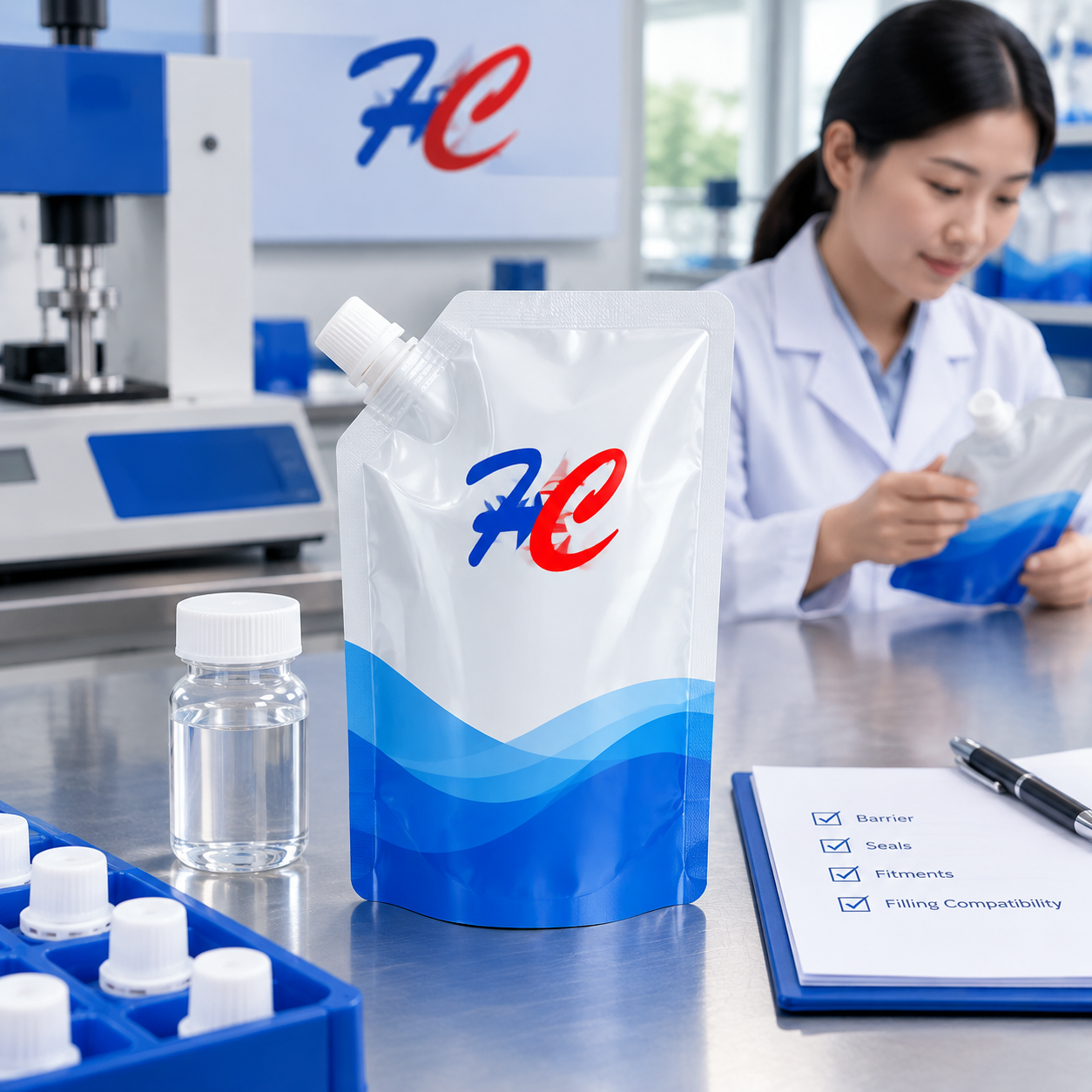
Barrier performance affects how a packaged product changes during storage and distribution. Oxygen can contribute to oxidation, color change, flavor loss, or reduced quality in susceptible products. Moisture can cause caking, loss of crispness, texture changes, concentration changes, or microbial concerns where the product and process make those concerns relevant.
Barrier selection should begin with the product rather than with a favorite film. Consider the product’s sensitivity, target shelf life, fill temperature, storage environment, package size, headspace, and expected distribution conditions. A small pouch and a large pouch made from the same film do not expose the product to the same packaging area-to-volume relationship.
For liquid products, barrier is only one part of the specification. Seal integrity, flex-crack resistance, fitment construction, cap performance, filling equipment, and drop or leak testing may be equally important. A high-barrier film cannot compensate for a weak seal or an unsuitable spout connection.
For products that benefit from shelf visibility, buyers can review options such as a transparent spout pouch for showing product color and fill level. Transparency may require a different barrier strategy than an opaque foil structure, so the visual requirement should be stated at the start of development.
How to Read OTR and WVTR Test Data
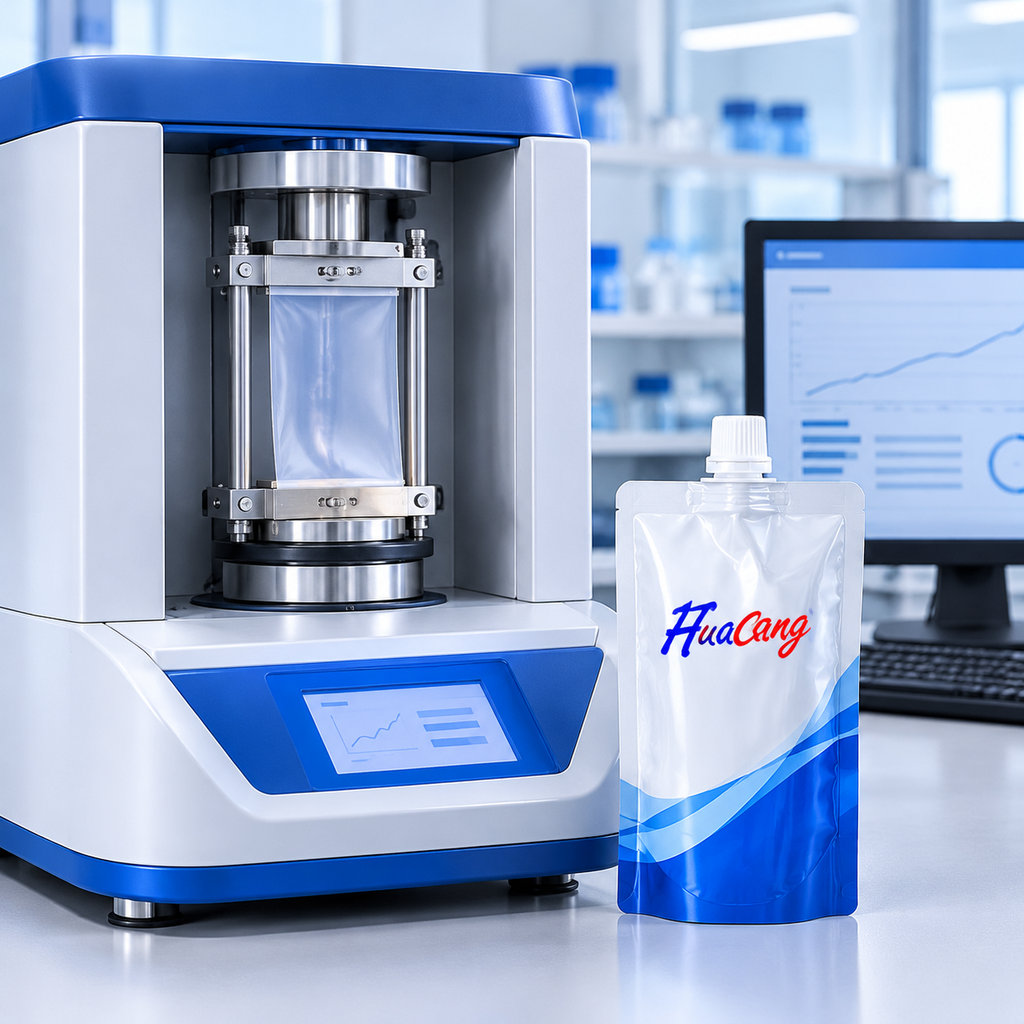
A reported OTR or WVTR value should always be read with its test method, temperature, relative humidity, specimen construction, and conditioning information. Comparing numbers from different conditions can lead to an incorrect material choice.
1. Check the unit
OTR is often reported in cubic centimeters per square meter per day, written as cc/(m²·day). WVTR is often reported in grams per square meter per day, written as g/(m²·day). Some laboratories or suppliers may use different area or time units, so convert them before comparing data.
2. Check temperature and humidity
Temperature and relative humidity can materially affect transmission. WVTR is particularly dependent on the humidity gradient across the specimen. OTR can also change with temperature and, for some materials, humidity. A result at room temperature and a stated humidity condition should not be treated as equivalent to a result at elevated temperature or another humidity level.
3. Check the test method
Commonly referenced methods include ASTM D3985 or ISO 15105-2 for oxygen transmission and ASTM F1249 for water vapor transmission. The method name alone is not enough; the laboratory report should also identify the instrument, specimen conditioning, and test conditions. For a finished pouch, ask whether the result applies to flat film, a pouch panel, or the complete package.
4. Check whether the result is a film value or package value
Film test data describes a controlled specimen. Finished-package performance can be affected by seals, folds, creases, flexing, pinholes, fitments, spouts, closures, and printing or converting conditions. For a spout pouch, the fitment and seal area deserve separate attention because the pouch is a multi-component system.
Buyer rule: Never request “the lowest possible OTR and WVTR” without defining the product, package format, test conditions, and required shelf life. Ask suppliers to report values on the same basis so competing structures can be evaluated fairly.
Flexible Packaging Barrier Structure Comparison
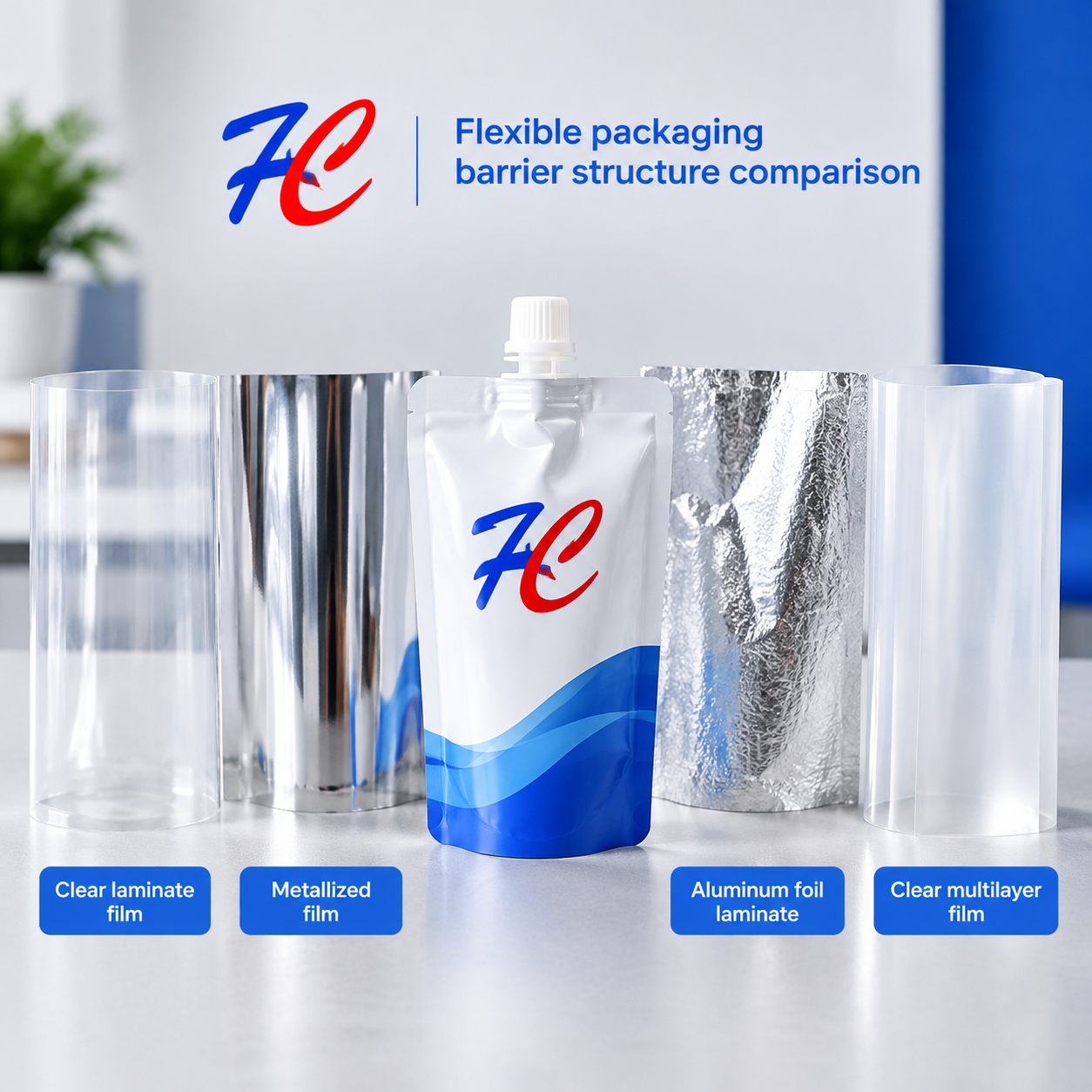
The following table is a starting point for technical discussion, not a substitute for product-specific testing. Exact performance depends on resin grades, layer thickness, lamination quality, conversion, package geometry, and test conditions.
| Candidate structure | Typical barrier direction | Visibility | Common evaluation points | Potential applications |
|---|---|---|---|---|
| Standard PET/PE or similar laminate | Basic-to-moderate protection; verify OTR and WVTR for the product | May be opaque or printable; depends on outer layer | Sealability, stiffness, cost, filling compatibility | Less sensitive liquids, household products, and short-to-moderate shelf-life formats |
| Metallized film laminate | Higher barrier than many standard clear films; performance depends on metallization quality and flexing | Metallic or partially opaque appearance | Flex-crack resistance, pinholes, print and seal construction | Products needing improved oxygen, moisture, or light protection |
| Aluminum foil laminate | Very strong barrier potential when the laminate and package are intact | Opaque | Creasing, pinholes, seal integrity, fitment area, package handling | Light-sensitive, oxygen-sensitive, or moisture-sensitive products |
| EVOH-containing laminate | Strong oxygen barrier under suitable humidity conditions; moisture can influence performance | Usually clear or printable, depending on the construction | Humidity exposure, layer design, sealant, processing conditions | Applications requiring oxygen protection with a non-metallic appearance |
| Mono-material PE candidate | Barrier level must be confirmed; may require coatings or specialized layers | Often printable or translucent | Recyclability pathway, seal window, stiffness, required barrier level | Projects prioritizing a compatible material system while meeting defined shelf-life needs |
There is no universally best high-barrier packaging film. The correct structure balances barrier targets with sealing, converting, filling, distribution, appearance, compliance documentation, and total cost. If the pack must be easy to carry, a handle spout pouch for larger liquid formats may add useful ergonomics, but its handle and seal geometry should be included in package validation.
How to Specify Barrier Requirements in an RFQ
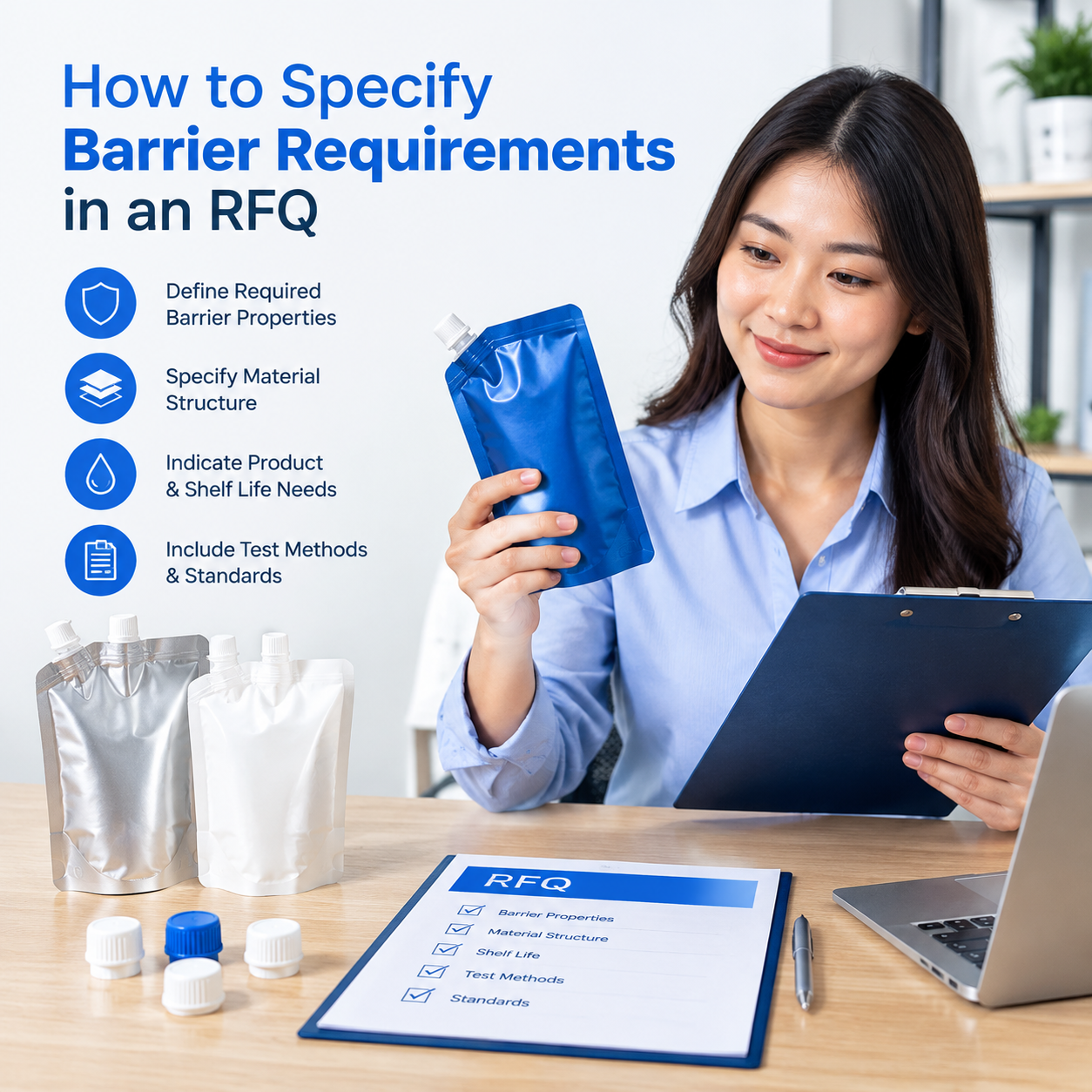
A useful RFQ gives suppliers enough information to recommend a structure and return comparable data. Include the following items:
- Product details: Product category, formulation, viscosity, pH where relevant, fat or oil content, oxygen sensitivity, moisture sensitivity, aroma sensitivity, and light sensitivity.
- Package format: Pouch style, dimensions, fill volume, headspace, spout position, cap or fitment type, and whether the package will be filled through the spout or from an open top.
- Processing conditions: Ambient fill, hot fill, pasteurization, retort, freezing, or other thermal exposure. State the time and temperature where known.
- Distribution environment: Expected temperature range, humidity, shipping duration, storage conditions, and whether the package may be flexed or compressed during handling.
- Barrier target: Requested maximum OTR and WVTR, with units, test temperature, humidity, test method, and whether the target applies to film or the finished pouch.
- Shelf-life objective: Target duration and the product quality limit that defines the end of shelf life, such as flavor, texture, moisture, color, or oxidation marker.
- Validation expectations: Number of samples, conditioning time, package aging plan, leak testing, seal testing, and any filling-line trial requirements.
If you do not yet know the target OTR or WVTR, provide the product and packaging shelf-life requirements instead. A packaging engineer can then propose candidate structures for sample testing, subject to confirmation through your product-specific validation plan.
How to Validate Packaging Shelf Life
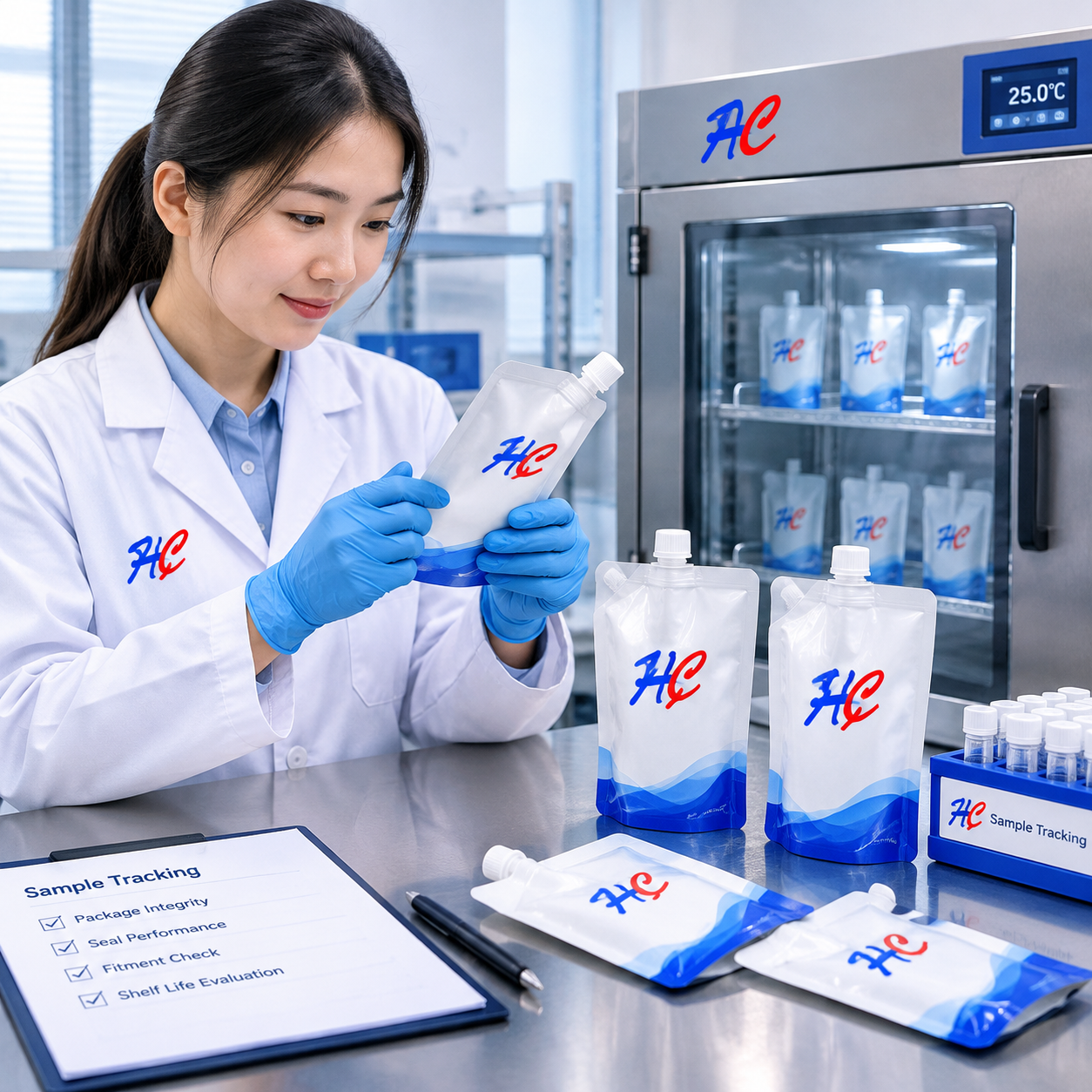
Barrier test data helps select a package, but it does not by itself prove shelf life. A practical validation program connects material data with the actual product and finished package.
- Define the failure criteria. Decide what change makes the product unacceptable. This may involve sensory quality, moisture pickup, oxidation, color, viscosity, concentration, or another product-specific measure.
- Screen candidate structures. Compare OTR and WVTR using matched test conditions. Include the complete proposed laminate and identify any assumptions.
- Fill representative samples. Use the intended product, fill volume, closure, seal settings, and filling process where possible. Samples made from flat film alone cannot reveal every pouch-level risk.
- Condition and age the samples. Use planned storage conditions that represent the market and include any accelerated condition only when its relationship to normal storage is understood.
- Inspect the package as well as the product. Check seals, spouts, caps, delamination, flex cracking, leakage, panel appearance, and dimensional changes alongside product quality.
- Document the approved specification. Record the structure, thickness, OTR and WVTR test basis, seal requirements, fitment, artwork version, sampling plan, and change-control expectations.
For a premium or distinctive pack shape, a customized shaped spout pouch for brand-led formats may introduce additional corners, seals, or stress points. Those features should be included in package-level barrier and integrity evaluation.
Key Takeaways for Packaging Buyers
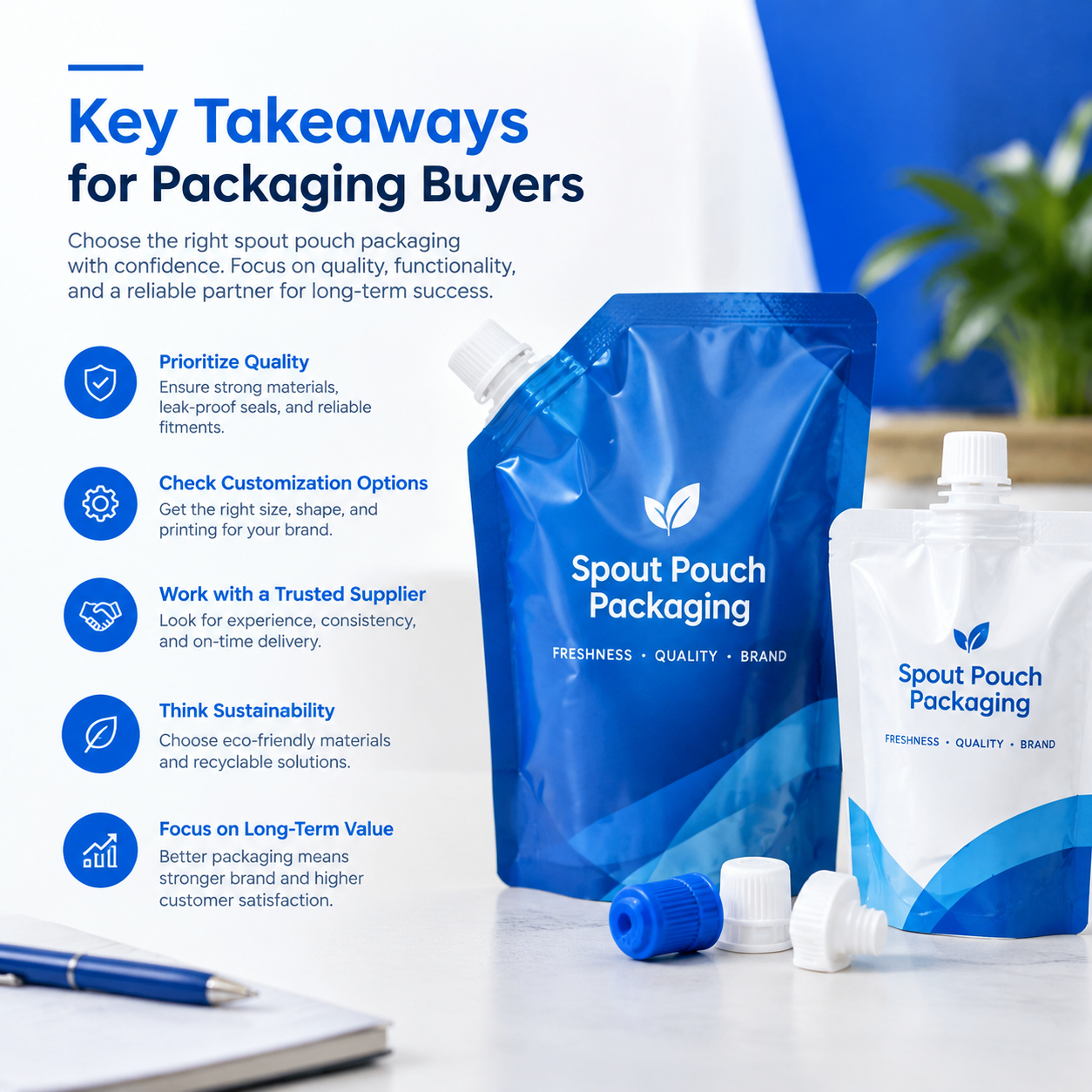
- OTR measures oxygen transmission; WVTR measures water vapor transmission.
- Lower values generally indicate stronger resistance, but only within comparable test conditions.
- Always request units, temperature, relative humidity, test method, specimen details, and conditioning information.
- Film values are not automatically finished-pouch values. Seals, fitments, folds, flexing, and defects can change package performance.
- Choose barrier requirements from product sensitivity and packaging shelf-life requirements, then validate the complete package.
- Include barrier targets and test conditions in the RFQ so suppliers can provide comparable proposals.
In short, OTR and WVTR are decision tools rather than standalone guarantees. A sound flexible packaging specification combines barrier data with product testing, package integrity, filling compatibility, and documented shelf-life validation.
FAQ
What is the difference between OTR and WVTR?
OTR is oxygen transmission rate, measuring oxygen movement through a packaging material or package. WVTR is water vapor transmission rate, measuring water vapor movement. OTR is commonly reported in cc/(m²·day), while WVTR is commonly reported in g/(m²·day).
Is a lower OTR or WVTR always better?
A lower value generally means greater resistance to oxygen or water vapor, but it is not automatically the best commercial choice. The result must be compared under the same test conditions, and the structure must also meet seal, filling, durability, appearance, compliance, and cost requirements.
Can a film OTR value predict the shelf life of a finished pouch?
Not by itself. A film result is measured on a defined specimen, while a finished pouch includes seals, folds, fitments, closures, and handling stresses. Product-specific shelf-life testing on representative filled packages is needed to confirm performance.
Which packaging materials provide high barrier performance?
Aluminum foil laminates, metallized films, and suitable EVOH-containing structures are commonly evaluated for higher barrier applications. The actual OTR and WVTR depend on the complete construction, thickness, processing, humidity, temperature, and package integrity, so supplier data and testing are required.
What should buyers include when requesting OTR and WVTR data?
Specify the product, package format, fill volume, intended shelf life, requested units, test temperature, relative humidity, test method, specimen type, and whether the target applies to flat film or the finished pouch. Also ask for conditioning information and any package-level validation data available.
Need Custom Spout Pouch Packaging?
Share your product, fill volume, packaging requirements, artwork, and estimated order quantity. Our packaging team can recommend a suitable pouch structure, spout option, and quotation.