Table of Contents
- What FDA Food-Contact Documents Actually Establish
- The Buyer’s Document Checklist
- Comparison of Common Compliance Documents
- Verify Conditions of Use, Not Just Material Names
- Documents to Request by Packaging Component
- How to Review a Documentation Package
- Statements That Do Not Prove Compliance
- Responsibility and Document Control
- Conclusion
A practical guide to the declarations, regulatory citations, specifications, supporting evidence, and conditions of use that US buyers should review when sourcing flexible food packaging.
What FDA Food-Contact Documents Actually Establish
FDA food-contact documents should establish that every food-contact component in a flexible package has an appropriate US regulatory basis for its intended use. Buyers normally need a supplier declaration supported by identifiable materials, applicable regulatory citations, use limitations, and controlled specifications. A one-line statement that a pouch is “FDA approved” is not enough.
Definition: A food-contact declaration is a supplier-issued statement describing the regulatory status of a material or finished packaging construction. It is not normally a certificate issued by the US Food and Drug Administration. Its value depends on its scope, accuracy, supporting records, and connection to the exact product being purchased.
FDA regulates substances that may reasonably be expected to migrate into food. A material may have a regulatory basis through a provision in Title 21 of the Code of Federal Regulations, an effective Food Contact Notification, a Threshold of Regulation exemption, a prior sanction, or another lawful basis. The applicable route can differ among resin, adhesive, coating, colorant, processing aid, ink system, and fitment components.
Compliance is use-specific. The same polymer can be suitable for one food type, temperature, or contact duration but outside its supported conditions in another application. Therefore, buyers should start with the packed food and filling process, then assess the complete pouch structure.
The Buyer’s FDA Packaging Compliance Checklist
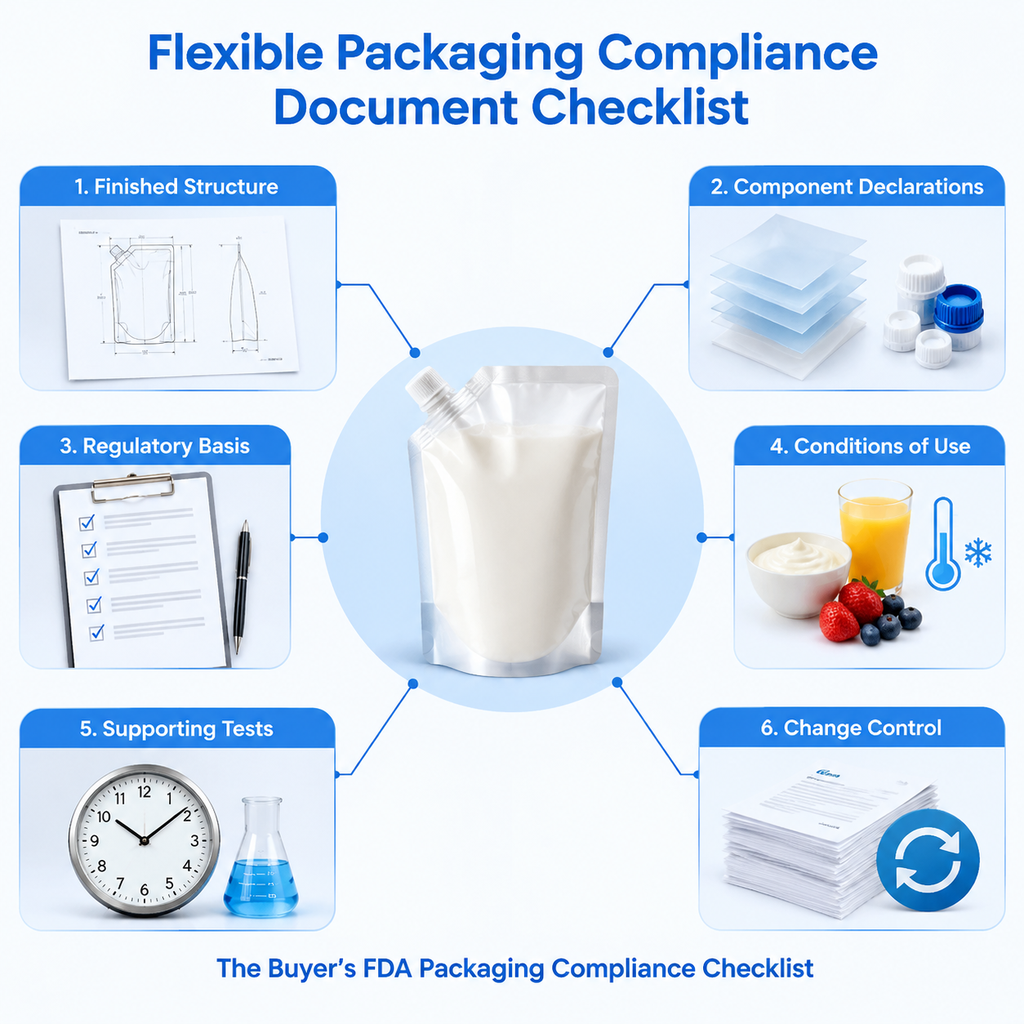
A useful document package connects the finished item number to its composition, regulatory basis, and intended conditions. For a printed spout pouch, the review should cover the film layers, sealant, tie layers, laminating adhesive, inks or coatings, spout, cap, gasket, and any other component that can contact food directly or through foreseeable migration.
Key takeaways
- Request a declaration for the exact finished structure or purchase specification, not merely a generic resin brochure.
- Confirm the declaration identifies food types, contact temperature, duration, and any repeated-use limitation relevant to the application.
- Ask for specific regulatory citations or notification references instead of accepting “FDA compliant” without explanation.
- Match the declaration to controlled film, adhesive, ink, fitment, and closure specifications.
- Treat migration or extraction reports as supporting evidence, not as substitutes for a complete regulatory assessment.
- Require suppliers to notify the buyer when a formulation or material source changes in a way that could affect compliance.
The buyer should also prepare an application brief. At minimum, record the food category, fat and alcohol content where relevant, pH, fill temperature, thermal process, storage temperature, expected shelf life, contact duration, and whether the package will be frozen, reheated, microwaved, irradiated, or used repeatedly. These facts define the compliance question the supplier must answer.
Comparison of Common Flexible Packaging Compliance Documents
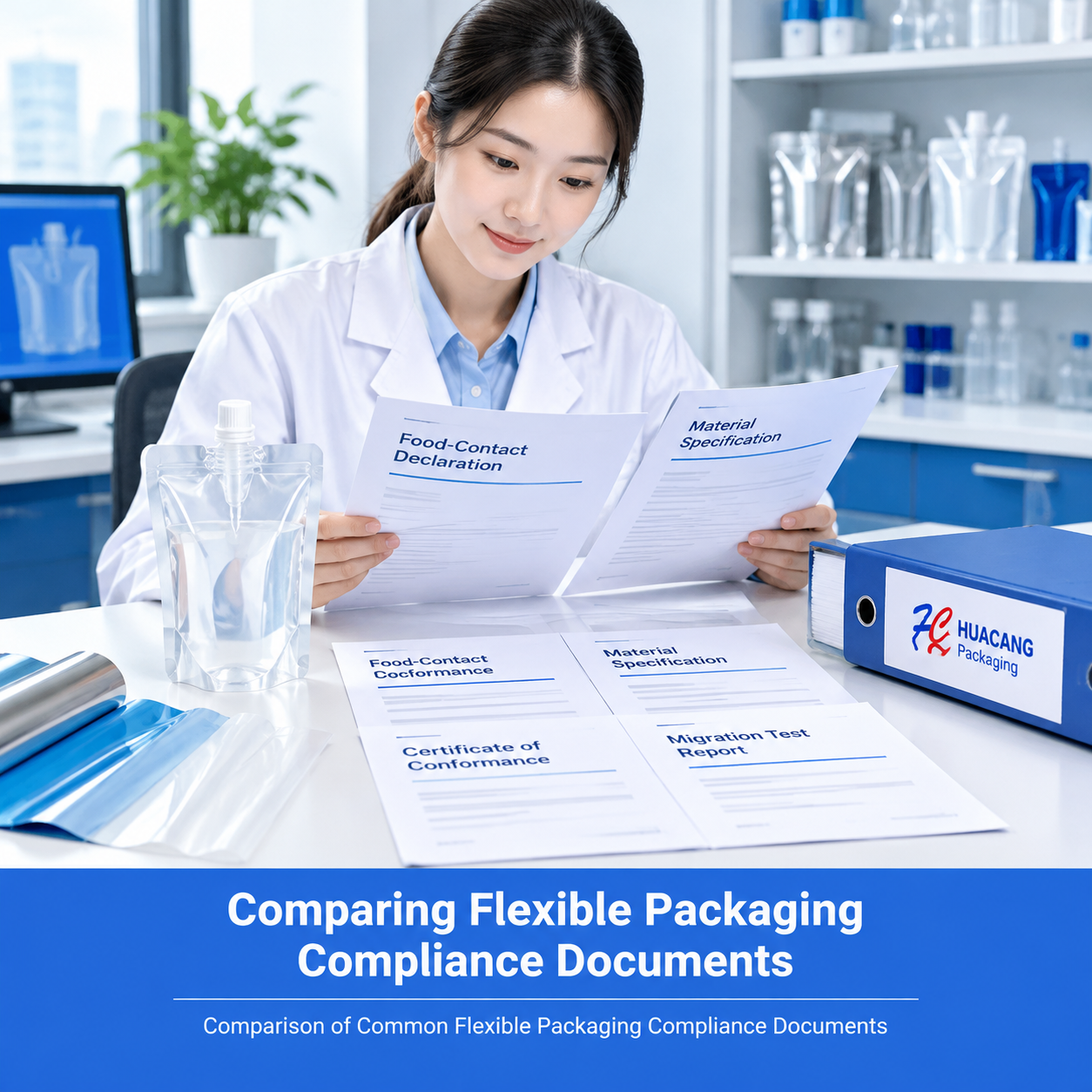
No single document answers every regulatory and technical question. Buyers should understand the purpose and limitation of each item in the supplier file.
| Document | What it should establish | What it does not establish by itself |
|---|---|---|
| Food-contact declaration | Product identity, applicable US regulatory basis, conditions of use, restrictions, date, and responsible issuer | Actual performance of the pouch or the suitability of an undeclared application |
| Material specification | Controlled resin, film, adhesive, ink, fitment, dimensions, or composition identifiers | Legal compliance unless regulatory status is also addressed |
| Technical data sheet | Typical physical properties, processing guidance, and intended applications | Conformance of a specific production lot or complete package |
| Certificate of analysis or conformance | Lot-specific results or confirmation against agreed purchasing specifications | A complete regulatory assessment when only physical properties are reported |
| Migration or extraction report | Results for defined samples, simulants, temperatures, times, and analytical methods | Suitability outside the tested scope or legal status of every ingredient |
| Food Contact Notification reference | An effective FDA notification covering a particular food-contact substance and stated conditions | Automatic coverage for a different manufacturer, formulation, concentration, or use when the notification is restricted |
| Safety data sheet | Workplace handling and hazard communication information for a chemical or preparation | Food-contact authorization for the finished packaging |
A buyer may not need every item for every low-risk application. However, a declaration, controlled specification, and enough supporting information to verify the declaration are a practical baseline for imported flexible packaging.
Verify Packaging Conditions of Use, Not Just Material Names
The most important review question is whether the regulatory basis covers the actual food and process. “Polyethylene is FDA compliant” is too broad because additives, layer composition, thickness, extractives limits, temperature, food type, and supplier-specific notifications can affect the conclusion.
Ask the supplier to state or map the intended use against these variables:
- Food type: aqueous, acidic, alcoholic, fatty, dry, or combinations relevant to the formulation.
- Temperature: room-temperature filling, chilled filling, hot fill, pasteurization, boiling-water treatment, retort, reheating, or cooking.
- Contact duration: short processing contact, long-term storage, or repeated use.
- Package geometry: direct-contact sealant surfaces, fitment contact areas, and layers that may transfer substances through migration or set-off.
- Special processes: freezing, microwave heating, conventional oven use, irradiation, or other processing outside normal ambient storage.
FDA provisions use defined conditions and limitations. The supplier should cite the applicable provision and explain the covered use rather than simply listing a regulation number. For example, a citation for an olefin polymer does not automatically establish that every additive, adhesive, or colorant in a multilayer pouch is covered.
If the commercial process has not been finalized, ask for declarations covering the proposed operating range. Later changes—such as moving from cold fill to hot fill or increasing alcohol content—should trigger a new regulatory review.
Documents to Request by Flexible Packaging Component
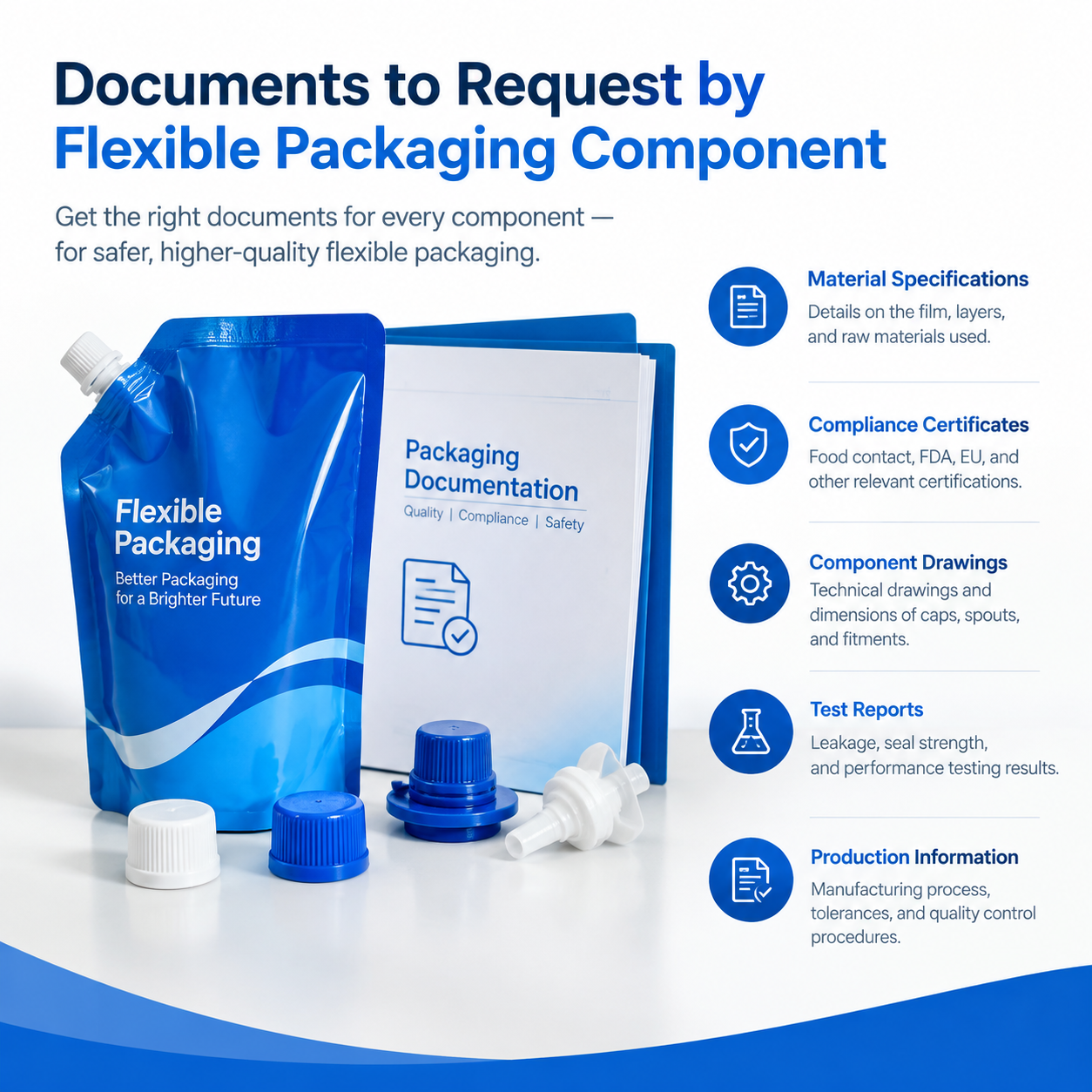
The documentation scope should follow the complete bill of materials. This is especially important for spout pouches because the film and dispensing components may come from different upstream suppliers.
| Packaging item | Documents and details to request | Application-specific checks |
|---|---|---|
| Multilayer pouch film | Finished structure, layer identities, food-contact declaration, regulatory citations, and controlled specification | Food-contact layer, barrier layer, temperature resistance, contact duration, and sealing process |
| Laminating adhesive | Adhesive identity or controlled code, applicable citation or notification, curing requirements, and restrictions | Mixing ratio, cure time, residual substances, process temperature, and whether a functional barrier is assumed |
| Printing inks and coatings | Ink-system declaration, location in the structure, use limitations, and controls for migration and set-off | Reverse versus surface printing, cure control, roll storage, and direct-contact exclusion |
| Spout, cap, valve, or gasket | Resin and additive declaration, colorant status, component specification, and relevant notification references | Direct food contact, tamper features, torque, temperature, chemical compatibility, and filling-line fit |
| Finished converted pouch | Declaration linked to the exact item number and structure, dimensional drawing, specification, and change-control commitment | Seal integrity, fitment weld, fill method, transport, shelf life, and final application validation |
Construction also changes the questions to ask. A transparent spout pouch structure may use different barrier and adhesive components than a foil laminate. A handle-equipped spout pouch for larger liquid packs adds handle-area and fitment considerations. A custom-shaped spout pouch still requires the same material review, while its geometry may require additional converting and seal validation.
Regulatory documents establish the basis for food contact; they do not prove leakage resistance, shelf life, machinability, or compatibility with the product. Those properties require separate engineering review and appropriate package testing.
How to Review a Supplier Documentation Package
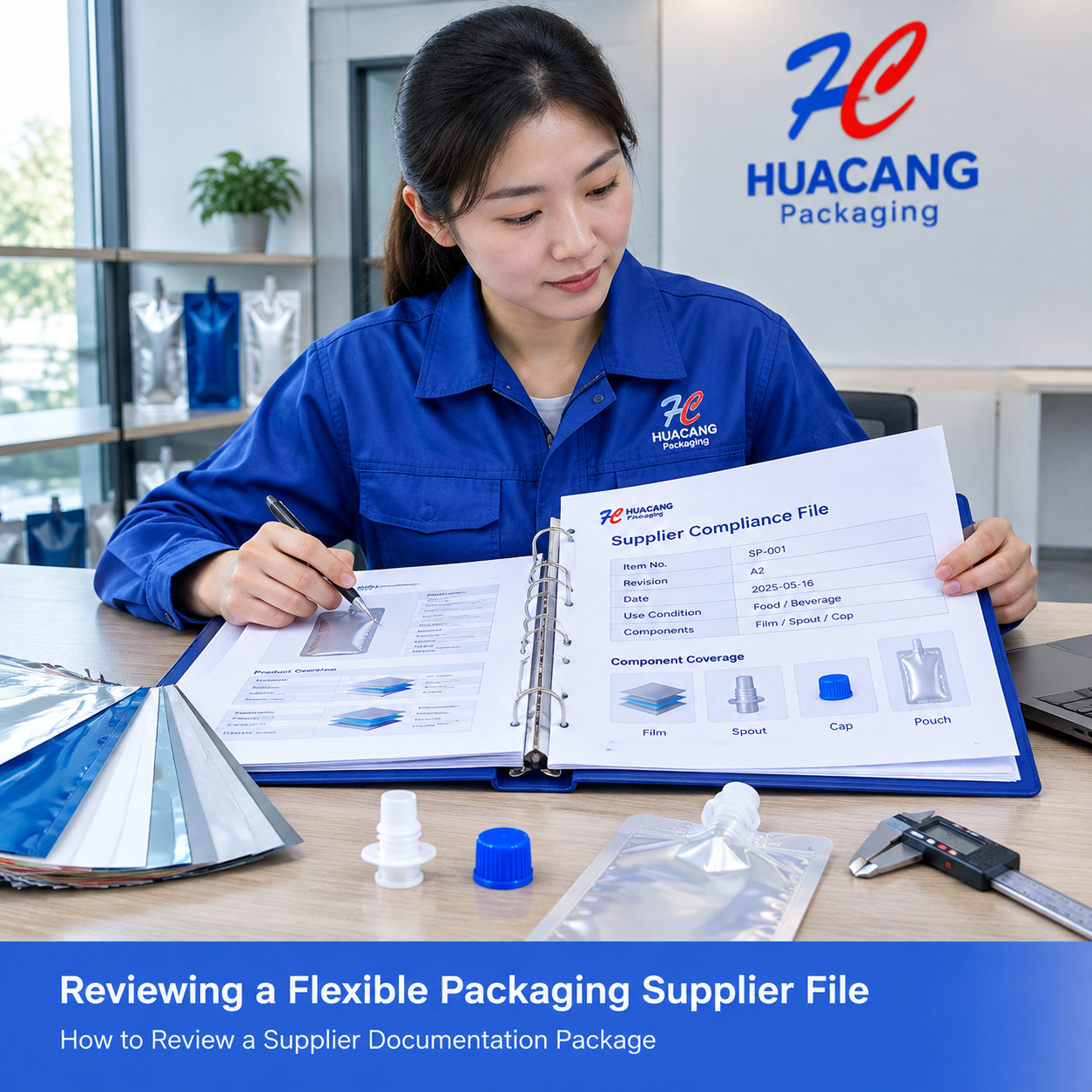
Reviewing flexible packaging compliance documents is easier when procurement, quality, packaging engineering, and regulatory personnel follow the same sequence.
- Define the use case. Record the recipe characteristics, fill process, maximum temperature, storage conditions, shelf life, and consumer use.
- Freeze the proposed construction. Obtain the film structure, total thickness, sealant identity, adhesive system, printing arrangement, and fitment specification. Confidential formulations can remain with the supplier, but traceable material codes are still needed.
- Check document identity. Verify the supplier name, document date, revision, item number, material code, manufacturing site where relevant, and authorized signature or responsible department.
- Review the regulatory basis. Confirm that cited regulations, effective notifications, exemptions, or other bases apply to the identified components and stated conditions.
- Compare limitations with the application. Look for maximum temperature, food-type exclusions, thickness limits, concentration limits, and conditions attached to a functional barrier.
- Resolve gaps in writing. Ask focused questions about missing layers, adhesives, inks, closures, or unsupported processing conditions. Keep the response with the approved specification.
- Validate the finished package. Conduct suitable compatibility, sealing, migration, shelf-life, filling-line, and distribution tests based on product risk and intended use.
- Control future changes. Define notification and reapproval requirements for substitutions involving resin, additives, adhesive, ink, fitment, or manufacturing process.
For critical applications, buyers may also request evidence that the declaration was prepared by a qualified regulatory contact and that underlying supplier documents are current. Confidentiality arrangements can allow a converter to confirm coverage without disclosing proprietary formulations to every commercial party.
Statements That Do Not Prove FDA Packaging Compliance
Common supplier statements may sound reassuring while leaving essential questions unanswered. Ask for clarification when a file contains any of the following:
- “Made from FDA-approved material.” This does not identify the regulation, notification, formulation, food type, or temperature.
- “Food grade.” The phrase has no useful scope unless the supplier defines the material, legal basis, and intended conditions.
- “FDA certified.” FDA does not ordinarily certify individual flexible packaging structures through a generic certificate. Determine who issued the document and what it covers.
- A resin declaration only. This can omit additives, adhesives, inks, coatings, fitments, colorants, and processing aids.
- An SDS or laboratory report only. Either can support a review, but neither automatically establishes a lawful basis for the complete package.
- An old declaration without item identification. It may relate to a discontinued formulation or another structure.
- A regulation list with no limitations. A citation is meaningful only when its restrictions and conditions are applied to the actual use.
Also distinguish food-contact status from facility registrations, quality-management certificates, and general product-safety reports. These records may be useful in supplier qualification, but they answer different questions. US food packaging requirements should be assessed through both regulatory documentation and finished-package validation.
Responsibility and Document Control
The converter should provide accurate information for the supplied construction, but the food company or party placing the packaged product on the US market must also determine whether the package is suitable for the intended food and process. Responsibilities should be stated in the purchasing specification or quality agreement.
Maintain an approved file containing the current drawing, material structure, declarations, supporting correspondence, test reports, approval decision, and revision history. Link it to the supplier, item number, artwork version, production site where relevant, and finished-product application. A practical retention period should reflect company policy, product shelf life, complaint investigation needs, and applicable legal advice.
Change control is particularly important. A film can retain the same commercial description while an additive package, adhesive, ink, or resin source changes. The purchase agreement should define which changes require advance notice, updated documents, samples, testing, and written reapproval.
For imported packaging, the documents generally form part of the buyer’s due-diligence and supplier-control records; they are not simply paperwork to collect after production. Completing the review before artwork approval and mass production reduces the risk of discovering an unsupported use after inventory has been manufactured.
Conclusion
Reliable FDA food-contact documents connect a precisely identified packaging structure to a lawful regulatory basis and the intended food, temperature, duration, and processing conditions. Buyers should request more than a generic compliance claim: obtain a structure-specific declaration, controlled specifications, component coverage, applicable limitations, supporting evidence, and change-control commitments. Complete the review before production and support it with validation of the final filled package.
FAQ
Does FDA issue a compliance certificate for each flexible package?
Generally, no. A flexible packaging supplier usually issues its own food-contact declaration based on applicable regulations, effective Food Contact Notifications, supplier documents, formulation controls, and other lawful bases. Buyers should verify the issuer, exact product scope, regulatory citations, conditions of use, restrictions, and document date rather than treating the declaration as an FDA-issued certificate.
What should a food-contact declaration contain?
It should identify the supplier, product or item code, material or finished structure, applicable US regulatory basis, intended food types, temperature and duration conditions, important restrictions, issue date, revision, and responsible issuer. For a multilayer pouch, the declaration should clarify whether it covers the complete construction, including adhesive, ink system, spout, cap, and other relevant components.
Is an FDA statement for the inner sealant layer enough?
Not necessarily. The sealant is important because it directly contacts food, but substances from adhesives, inks, coatings, tie layers, colorants, and fitments may also require assessment. The review should cover the complete package and any functional-barrier assumptions. A statement for one layer cannot automatically be extended to the entire pouch.
Are migration tests mandatory for every flexible packaging order?
Testing needs depend on the material, regulatory basis, intended use, available supplier evidence, and the buyer’s risk assessment. Some regulatory provisions specify extractives or other limitations, while other situations may require targeted migration work to support suitability. A test report must be reviewed against its sample, simulants, time, temperature, method, detection limits, and intended application.
When should FDA food-contact documents be updated?
Review documents when the film structure, resin source, additive, adhesive, ink, coating, fitment, colorant, manufacturing process, food formulation, fill temperature, thermal process, or intended use changes. Buyers should also establish a periodic review process so expired, superseded, or untraceable declarations do not remain in the approved supplier file.
Need Custom Spout Pouch Packaging?
Share your product, fill volume, filling conditions, required pouch structure, spout fitment, artwork, estimated order quantity, sample needs, and documentation requirements. Our packaging team can review the project and prepare a suitable packaging quotation.