Table of Contents
- What Are Baby Food Spout Pouches?
- Start With the Product and Filling Process
- Choose the Pouch Format and Spout Position
- Specify the Laminate Structure
- Select the Spout and Cap
- Set Dimensions, Capacity, and Headspace
- Confirm Filling Machine Compatibility
- Build a Validation and Quality Plan
- Prepare Artwork and Order Information
- Baby Food Spout Pouch RFQ Checklist
Learn how to specify baby food spout pouches for puree and semi-liquid products. This buyer guide covers pouch format, laminate structure, spout and cap selection, filling compatibility, validation, artwork, and RFQ requirements.
What Are Baby Food Spout Pouches?
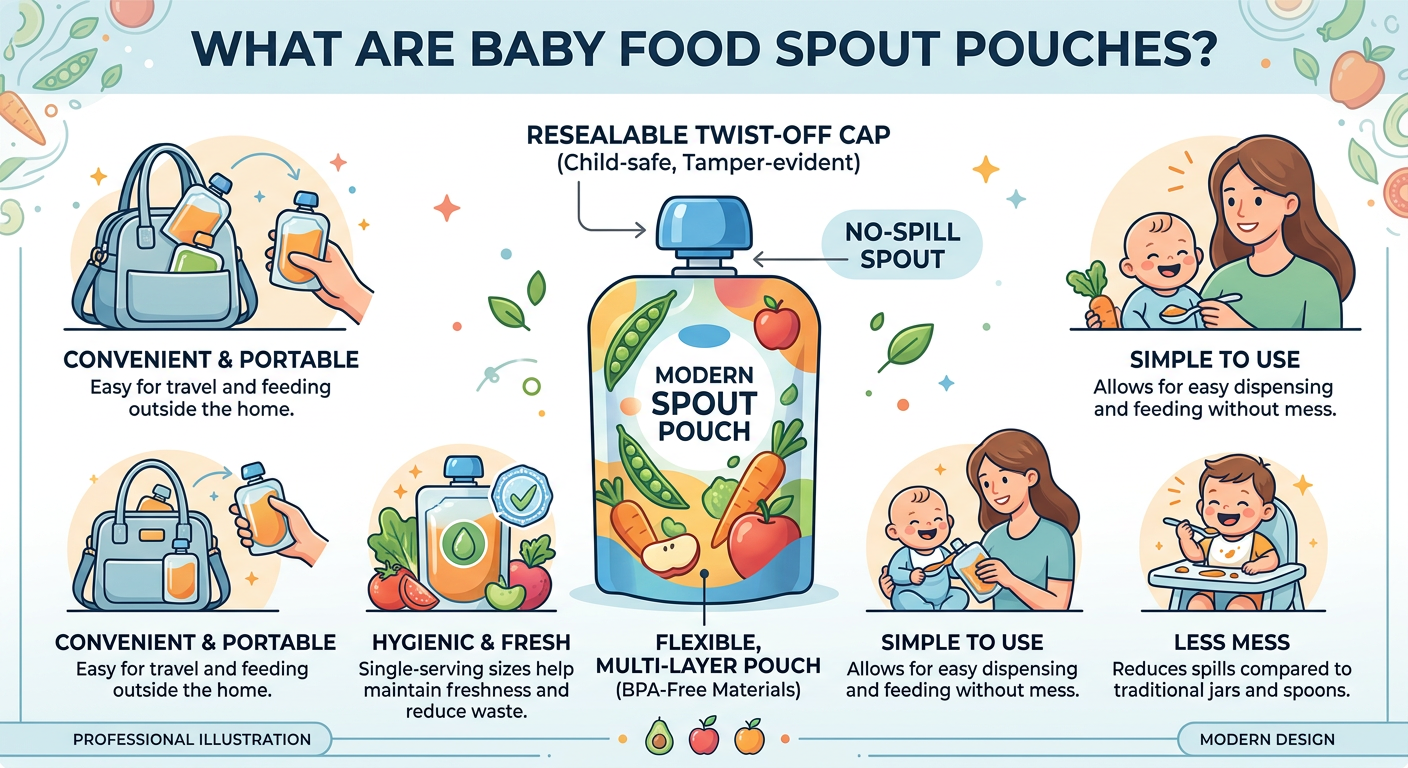
Baby food spout pouches are flexible, multilayer packages with a heat-sealed dispensing fitment and reclosable cap, commonly specified for fruit, vegetable, dairy-based, and blended puree products. For a buyer, the right pouch is not selected by appearance alone. It must be engineered around the recipe, viscosity, particle size, thermal process, intended shelf life, filling equipment, distribution conditions, and required consumer use.
A typical pouch combines a printed outer web, one or more functional barrier layers, and a food-contact sealant layer. The spout is sealed into the pouch during converting, and the cap closes the fitment after filling. Depending on the product and process, a buyer may request a stand-up pouch with a bottom gusset, a shaped pouch, or a flat format. The supplier should confirm the complete construction rather than treating “baby food pouch” as a standard, one-size specification.
This guide assumes commercially packed puree or semi-liquid foods sold in single-serve or multi-serve flexible pouches. Product safety, process authority decisions, labeling, migration requirements, and market-specific regulatory obligations remain the responsibility of the brand and its qualified food-safety and regulatory teams.
Start With the Product and Filling Process

The product and process define the packaging brief. Before selecting film or fitments, provide the pouch manufacturer with a representative product description and the intended packing conditions. A fruit puree, a grain-containing blend, and a dairy-containing formulation may place different demands on barrier, seal performance, and process validation.
Information to define before requesting a quotation
- Product composition: key ingredients, oil or fat content, acidity, dairy content, and any ingredients that may affect package compatibility.
- Physical behavior: viscosity range, particle or fiber size, aeration, and tendency to settle or separate.
- Filling process: ambient, warm, hot fill, retort, or another validated process; state the actual target fill temperature and dwell conditions where applicable.
- Distribution model: ambient, chilled, frozen, or mixed distribution; expected handling and transport conditions.
- Target life: required unopened shelf life and any performance expectations after opening.
- Pack use: single serving, multiple servings, spoon-feeding, direct consumption, or dispensing into another container.
Do not assume that a laminate suitable for one puree is suitable for every recipe or thermal process. The correct approach is to document the actual process, nominate preliminary materials, and validate the final pouch on the brand’s product and line conditions. For a deeper review of layer functions and selection questions, see this guide to choosing spout pouch laminate materials.
Choose the Pouch Format and Spout Position
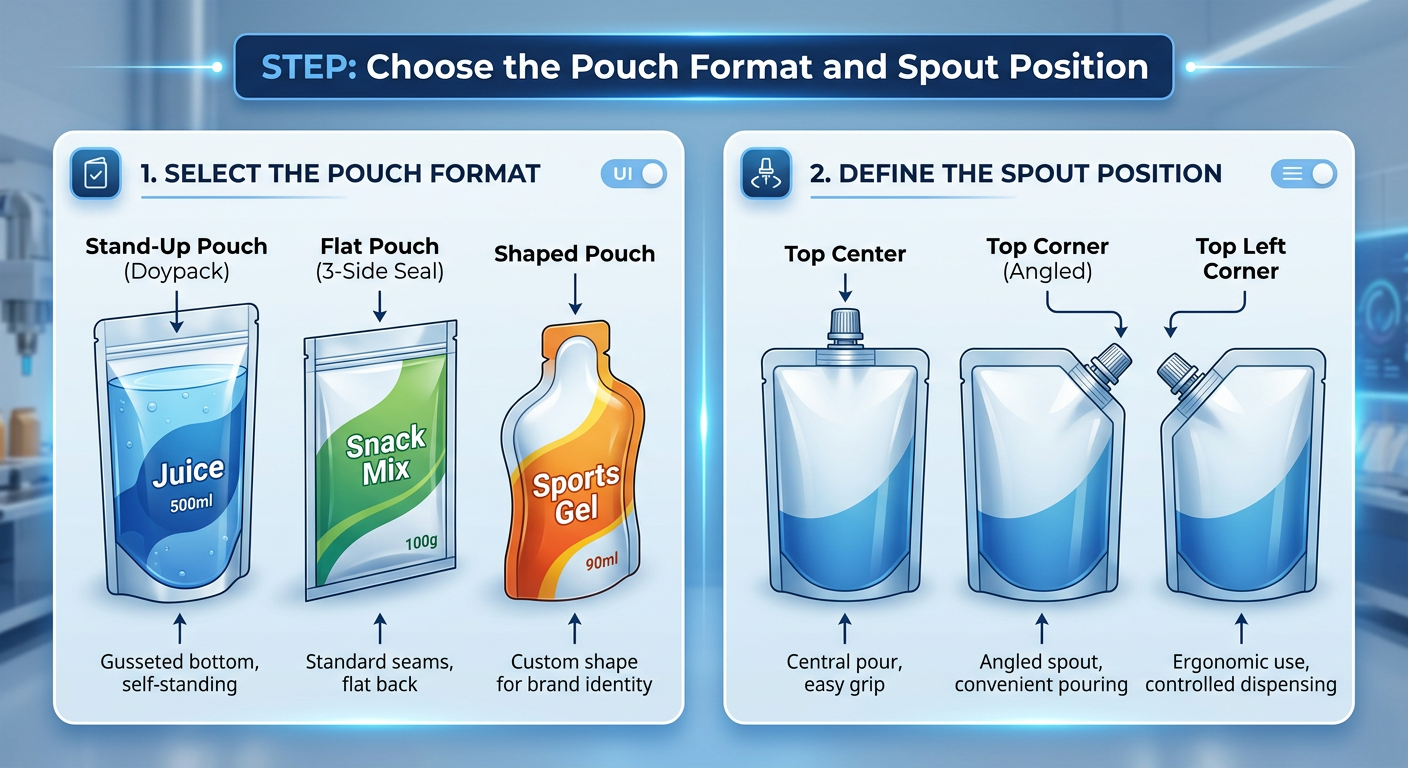
Format selection affects filling, shelf presentation, consumer handling, material use, and artwork area. A stand-up pouch is often considered when upright retail display is important, while a flat pouch may suit certain portion sizes or packing configurations. The selected format should provide stable sealing areas around the fitment and sufficient practical space for filling and headspace.
For baby food spout pouches, the most common fitment locations are top spout and corner spout. Neither is universally better. A top spout can support a centered appearance and may align with certain filling arrangements. A corner spout can change how the pouch is held and dispensed and may provide a different front-panel layout. The decision should account for cap clearance, carton orientation, filling equipment, and the intended user experience.
Review the pouch profile with a dimensioned drawing before approving tooling or cylinders. The drawing should identify overall width and height, gusset dimensions where used, spout centerline and orientation, seal widths, material structure, and tolerances. Buyers comparing the two basic layouts can use this corner spout versus top spout pouch comparison to frame the decision.
Specify the Laminate Structure
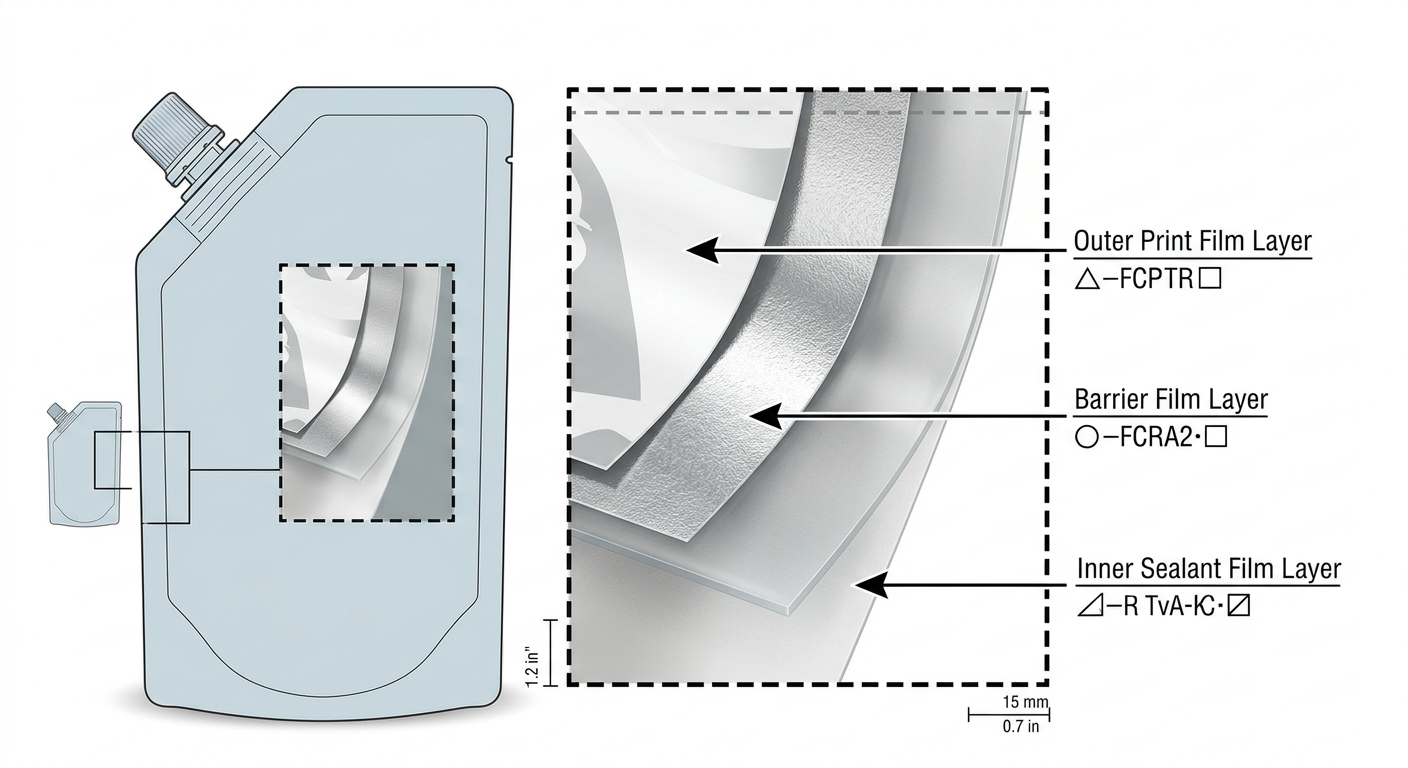
A laminate structure is a functional system, not simply a list of films. In general, the outer layer provides print support and external durability; middle layers can contribute barrier or stiffness; and the inner layer provides the food-contact surface and heat-seal performance. The exact structure must be selected for the product and process.
Key specification questions include:
- What barrier is needed against oxygen, moisture, aroma loss, or light exposure?
- Will the pouch encounter elevated filling or processing temperatures?
- What sealant is needed for reliable pouch seals and fitment-area sealing under the planned conditions?
- Does the product contain oils, acids, pigments, or particulates that require compatibility evaluation?
- Is a clear window needed, and if so, how does it affect barrier and artwork requirements?
- Are material or recycling-design preferences part of the project brief? If yes, define the target market and requirements early rather than assuming a particular claim is available.
Aluminum foil, metallized films, transparent high-barrier films, and polymer sealant layers can each have a role in flexible packaging, but their suitability is application-specific. Material selection should be reviewed alongside the validated thermal process and shelf-life protocol. This spout pouch material structures buyer guide explains the decision factors in more detail.
Select the Spout and Cap
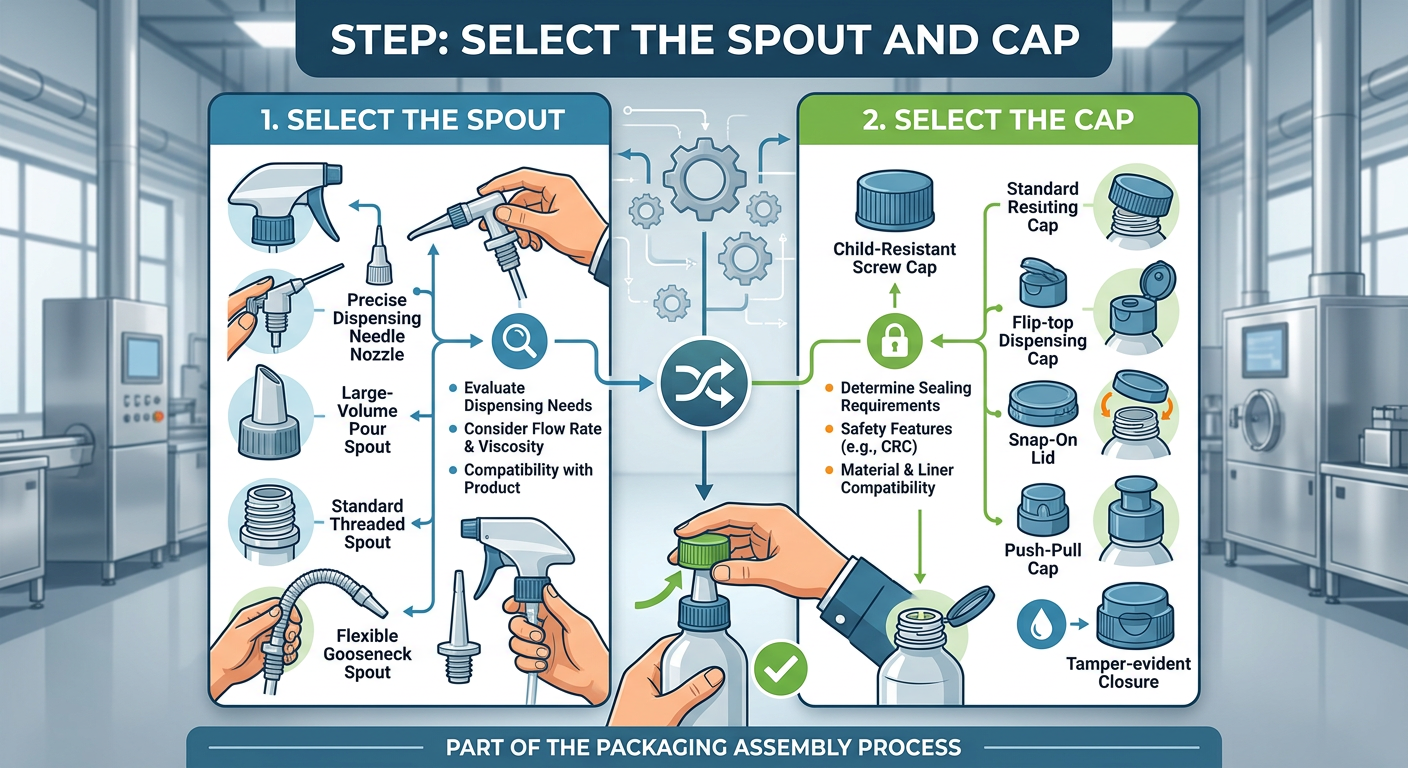
The spout and cap must be considered as a matched fitment system. Specify the spout diameter, bore geometry, cap style, cap color, tamper-evidence requirement where applicable, and attachment or application method. The final choice should allow the actual puree to flow as intended without creating avoidable filling restrictions or consumer-use issues.
Viscous blends and recipes containing fibers or small particles require particular attention. A smaller opening may be appropriate for some applications but can be less forgiving for thicker products. Conversely, a larger bore may influence fitment size, filling hardware, pouch layout, and cost. The packing line must also be able to handle the selected spout and cap consistently.
Ask the supplier to document fitment dimensions, resin family where relevant to the specification, and the intended process range. Confirm whether caps arrive preassembled, how cap torque or closure application is controlled on the line, and which tests will be used to evaluate fitment sealing and closure integrity. Review this spout pouch caps and fitments selection guide when preparing the fitment brief.
Set Dimensions, Capacity, and Headspace
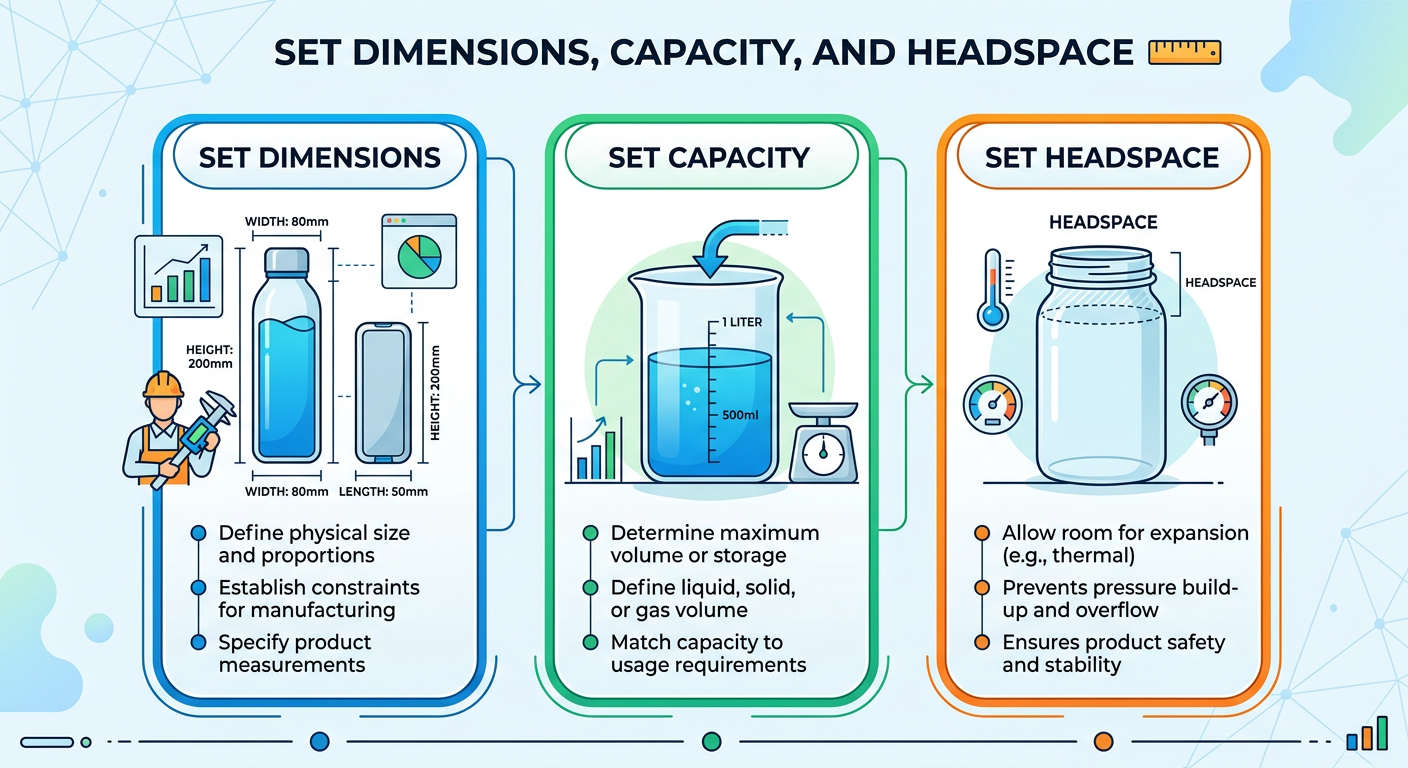
Nominal volume alone is not enough to define a pouch. The filled capacity depends on pouch width, height, gusset geometry, seal areas, fitment displacement, product density, and the selected fill level. A 100 g fill weight does not automatically equal 100 mL because density varies by recipe.
Provide the target net weight, product density or estimated specific gravity, target fill volume, acceptable fill tolerance, and required headspace. Headspace should be determined by the filling process and product behavior, not by an arbitrary visual target. It can affect filling accuracy, seal-area cleanliness, pouch shape, and the ability to manage product expansion or entrapped air under relevant conditions.
Request prototype samples or a pre-production trial to establish the practical fill level. For a structured approach to this stage, consult the spout pouch sizes and capacity guide.
Confirm Filling Machine Compatibility

A pouch can be well designed on paper and still perform poorly if it is not matched to the filling line. Share the machine type, operating orientation, filling nozzle arrangement, capper configuration, expected line speed range, and any handling limitations with the pouch supplier. If the line is not yet selected, state that clearly so the pouch design can retain appropriate flexibility.
Critical interfaces include how the pouch is indexed and opened, how the fitment is located during filling, whether product can contaminate the sealing area, how the cap is applied, and how finished pouches are conveyed and packed. Pouch stiffness, gusset geometry, spout position, and cap profile may all influence these steps.
Conduct a line trial with production-intent pouches whenever possible. A trial should examine filling consistency, pouch handling, seal-area cleanliness, cap application, visual appearance, rejects, and packing into secondary packaging. Use the spout pouch filling machine compatibility guide as a checklist for supplier and co-packer discussions.
Build a Validation and Quality Plan

Validation should reflect the actual product, process, and distribution environment. It is not sufficient to rely only on visual approval of empty samples. Before commercial release, agree on what will be tested, who is responsible, sampling frequency, acceptance criteria, and how deviations will be handled.
A project-specific plan may include checks for pouch dimensions, print appearance, seal appearance, fitment position, cap engagement, and package integrity. The appropriate leak or integrity method depends on the package design and the conditions being evaluated. Tests should be performed using agreed procedures and should not be interpreted as proof of product safety or shelf life on their own.
Consider transportation and secondary-pack evaluation as part of the plan. Carton configuration, palletization, compression, temperature exposure, and handling can influence finished-pack performance. For practical discussion points, see how to test spout pouch leak resistance.
Prepare Artwork and Order Information
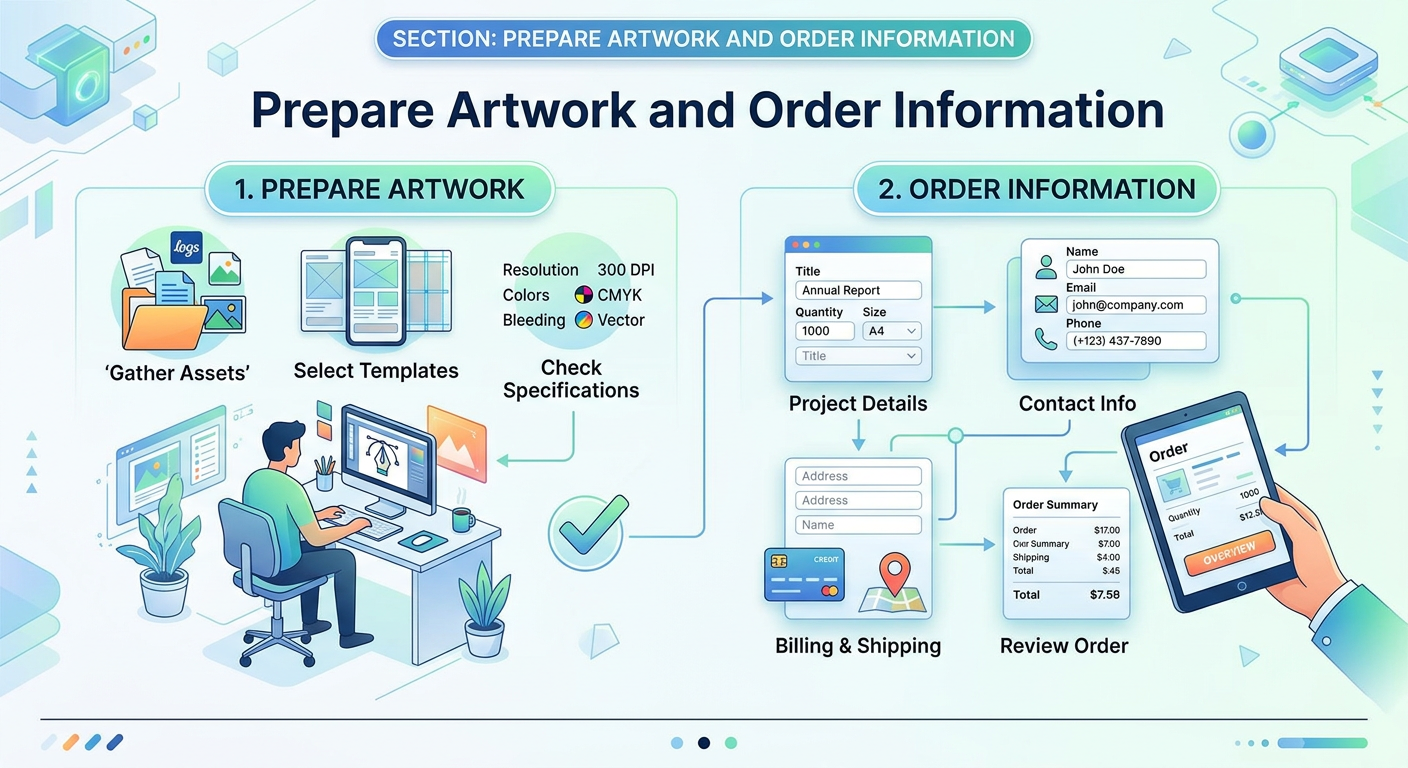
Artwork approval is a technical as well as a marketing step. Provide final dielines, required text, barcode specifications, color targets, legal copy, lot-code area, and any printer marks needed by the converting process. Keep essential text away from seals, gusset folds, curved fitment areas, and variable print zones.
Confirm whether the design uses surface printing or reverse printing within a laminate, the required finish, number of colors, and any white or metallic effects. The pouch supplier should issue a proof and production specification for approval. Color appearance can vary with substrate, ink system, finish, and viewing conditions, so agree on the approval method before full production.
For custom orders, commercial variables commonly include pouch size, material structure, spout and cap type, print coverage, number of artwork versions, order quantity, and delivery terms. Buyers can review the major variables in this guide to custom spout pouch cost factors.
Baby Food Spout Pouch RFQ Checklist
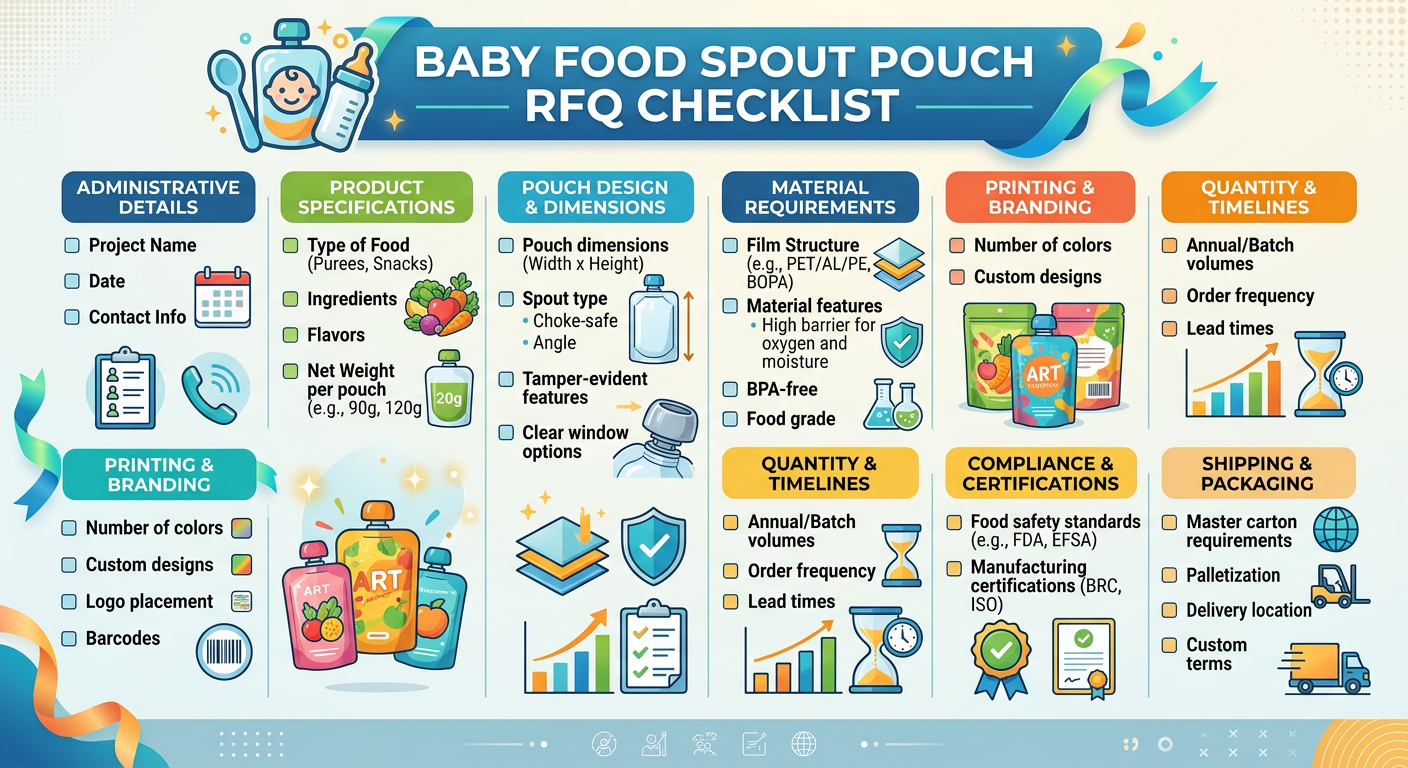
A complete RFQ reduces avoidable revisions and helps the manufacturer provide a more relevant technical and commercial response. Include the following information:
- Product type, key ingredients, viscosity, particle size, and product density if known
- Target net weight, fill volume, desired pouch format, and anticipated annual volume
- Filling process, fill temperature, process conditions, and distribution environment
- Target shelf life and any required barrier objectives
- Pouch width, height, gusset requirement, and preferred spout location
- Spout diameter, cap style, color requirements, and any requested tamper-evident feature
- Preliminary laminate preference, or permission for the supplier to recommend a structure
- Artwork files, number of SKUs, print colors, finish, barcode, and coding-area requirements
- Filling machine or co-packer details, including machine constraints and trial availability
- Required samples, validation plan, destination country, delivery terms, and desired timing
Use this information to compare supplier responses on the same basis. The most useful quotation identifies the proposed pouch structure, fitment specification, dimensions, printing assumptions, order quantity, lead-time assumptions, and items that still require validation.